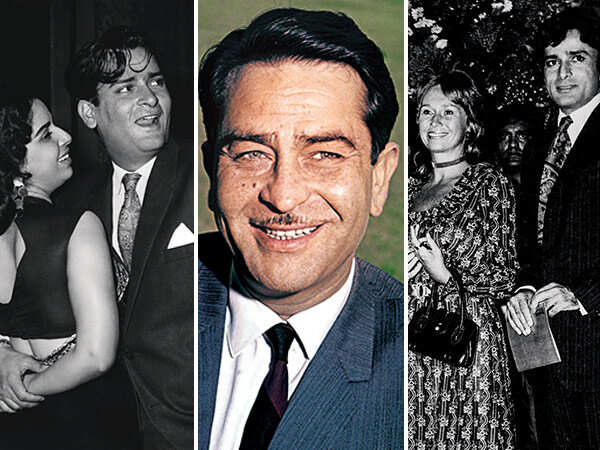


Entrepreneur Aditya Raj Kapoor, son of the late Shammi Kapoor, shares insights about the three brothers – Raj, Shammi and Shashi – whom he observed in close proximity. “Only a Prithviraj Kapoor could have sired such a bloodline. By choice, I have stayed far from the ‘life and breath’ of the industry. Though at one point I did nurture dreams of celluloid greatness,” smiles 69-year-old Aditya, who’s just completed his Masters in Philosophy. “What we have inherited from these legends is our zest for life and the movies. Rajji wove music and message into cinema, Shammiji celebrated the rhythm of life and Shashiji its layered possibilities. I wonder if destiny planned this package of performers/filmmakers all in one family just to create a cinematic heirloom. I guess it did,” he asserts. In Aditya Raj Kapoor’s own words:
SHOWMAN RAJ KAPOOR
The persona of my Dadaji Prithvirajji (Kapoor) was gigantic. The three sons, who succeeded their legendary father, my eldest uncle Raj Kapoor, my dad Shammi Kapoor and youngest uncle Shashi Kapoor, also left an indelible stamp given their individual style, sensibilities and star power.

I remember my father Shammiji telling me that when he wanted to buy his first car he asked Rajji for a loan. Instead, Rajji signed a blank cheque and told him to buy one. When my mother Geeta Bali passed away in 1965, Rajji insisted that my dad Shammiji, a grieving widower, stay in his house for three-four months. This was at the height of Shammiji’s career. I am told that Randhir had to give up his room for dad. Rajji’s wife, Krishnaji (Kapoor) nursed dad back to fighting fit or rather ‘dancing fit’! Shammiji went on to complete Teesri Manzil (1966), which awaited his return from mourning.

Rajji earned early success as an actor and at the age of 24 founded R. K. Films. He made his directorial debut with Aag in 1948. Making socially relevant and conscience-stirring films including Andaz, Barsaat, Awaara, Aah, Shree 420, Chori Chori, Jagte Raho and Prem Rog, Ram Teri Ganga Maili in the ’80s, Rajji packaged his message with commercial craftsmanship.
Rajji sought self-identity through his films, through his characters. He’s also referred to as the ‘Charlie Chaplin of Indian cinema’. Charlie Chaplin as the ‘Little Tramp’ inspired Rajji. Chaplin represented hope against hopelessness, something Rajji also personified in his black and white films. When black and white turned into colour, the 1964 Sangam being Rajji’s first colour film, the ‘tramp’ became the Showman. Rajji realised his eminence in the artistic and commercial platform of cinema. His persona and projects were considered larger-than-life. The annual R.K. Holi celebration at R.K. Studio was an event to watch out for. It started with a prayer to his late parents and then the sprinkling of colour on all present, followed by a dip in the tank near his cottage. The event was attended by A-listers. They came to the party in white and went back drenched in colour.
We celebrated many special occasions at each other’s homes usually Rajji’s bungalow. It could be a movie release, a birthday bash or a festival. You’d get to meet industry heavyweights at Rajji’s parties. A lavish spread would be laid out as brunch and would continue till dinner. Krishna auntyji’s birthday party kicked-off during the day so you could eat as much you wished before being packed off to bed.
SHAMMI KAPOOR

Times were changing too. Socialist cinema gave way to rom-com, where my father was at the forefront. Contrary to belief, Dad didn’t copy Elvis Presley. In fact, if Elvis had been born in India, he’d have surely danced like Shammi Kapoor. Elvis’ leg-shaking took him some distance before his voice and looks took over. Shammiji went all out moving his hips along with his distinctive pigeon-walk. Besides, his style was persona driven. Shammiji was in your arms, before you knew it. His songs tell his story but Deewana hua badal (Kasmir Ki Kali) does it the best. It has a melodious rhythm, which you may not dance upon, but certainly enjoy.
Basically, Shammiji was the curious sort. Initially, he wanted to join the air force but his father stopped him. Then when 16 of his early films flopped, he wanted to become a tea plantation manager. My mother, Geetaji, told him there was no need to go anywhere as his next film would be a hit. Dil Deke Dekho (1959) did wonders.

Shammiji was also interested in electronics and music systems so much that he set up his own Akai system at home. He was also regarded as an ‘Internet pioneer’. His niece, the late Ritu Nanda, handheld him and took him into the world of computers. He set up the Kapoor family website in the early ’90s. The point is that he saw more than the length of his shadow.
SHASHI KAPOOR
Shashiji married the British Jennifer Kendall in 1958, an early indication of his being a ‘different’ Kapoor. He was a thorough gentleman. He distributed compliments easily. People felt comfortable with him. He was my favourite because he spoiled me with extra pocket money.

Tough he had several commercial hits, Shashiji’s best work was in parallel cinema including Merchant Ivory Production’s The Householder, Shakespeare-Wallah, Bombay Talkies, Heat And Dust, In Custody and Hermann Hesse’s Siddhartha. Films produced by his own production house Film-Valas include Junoon, Kalyug, 36 Chowringhee Lane, Vijeta, Utsav and Ramesh Sharma’s New Delhi Times (1986). His performance in Shyam Benegal’s Kalyug (1981) is one of his best.
He helped Jennifer aunty get Prithvi Theatre on its feet again, as a tribute to his father Prithviraj Kapoorji and his theatrical legacy. Jennifer Kendal later realized Prithviraj’s dream of a permanent “home” for the company by inaugurating the modern Prithvi Theatre in Mumbai in 1978. He even spent his personal money on it. Even after Jennifer aunty passed away, he’d spend most of his evenings there, interacting with the audience at the cafeteria in his humble manner. His children Kunal, Karan and Sanjana have been involved with Prithvi Theatre in some capacity
KAPOOR QUEENS
One must appreciate the fact that the Kapoor women had to deal with their spouses coming back home deplete of any emotions. As all of it had been offered at the altar of the day’s shoot. The wives had to stay grounded and real.

Jennifer aunty was the most amazing Kapoor. She didn’t care for paya curry or comic books. Her staff wore formal tunics. She was as Indian as the British are but held her own. She celebrated all festivals and looked the prettiest in raw-silk sarees with bangles and bindi. She did not consider the superstardom of the Kapoor family any more than she had to. She taught her children to be simple. I remember her taking us for swimming to the Sun-n-Sand hotel in Juhu. She was pregnant with Sanjana then. I was young and shocked to see that. She was clearly an individual, who believed in herself and allowed her existence to appear important to her.
Shashiji was surely devastated after her demise. He never showed it as he was too much of a gentleman and grief is a private affair. Jennifer aunty designed his clothes, his diet, his outlook, his life… and then she suddenly left. It was an extremely sad moment for the family. Her annual Christmas lunch tradition was continued by Shashiji and now by Kunal.
Also Read: Exclusive: Vaani Kapoor reveals the best advice she got from Aditya Chopra

 By
By