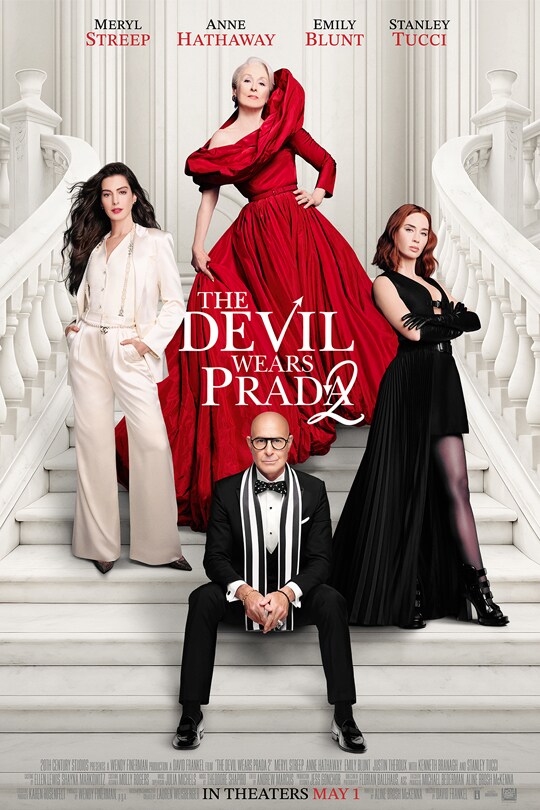

Meryl Streep, Anne Hathaway, and Emily Blunt’s reunion after two decades is worth the wait and makes for a highly entertaining sequel to their successful 2006 comedy.
Rating: 
 (3.5 / 5)

By Mayur Lookhar
A long wait for a sequel isn’t ideal, but it’s very much in vogue. In India, we weren’t bullish about Gadar 2 (2023) and Border 2 (2025), both films that arrived over two decades later than their respective originals. Critically panned, but their box office success revealed that nostalgia does sell. Well, if you thought two decades was a long wait, then Top Gun: Maverick (2022) and Beetlejuice Beetlejuice (2024) arrived 36 years after their respective originals.
By that count, a 20‑year wait for The Devil Wears Prada 2 feels short. However, its lead cast was initially reluctant, as they didn’t want to ruin the legacy of the original film. But like in the film, it was fate that reunited Meryl Streep, Anne Hathaway, director David Frankel, and writer Aline Brosh McKenna. A revisit of the original helps set in the nostalgia and build intrigue around the sequel. What do the writer and director have to offer now? More on that later, but first let’s recollect the genesis of this story.
Adapted from author Lauren Weisberger’s book of the same name, it is long believed that The Devil Wears Prada is a roman à clef of Weisberger’s experience as an assistant to then Vogue Editor‑in‑chief Anna Wintour, with Meryl Streep’s character Miranda Priestly loosely inspired by the former, while Weisberger saw herself in Anne Hathaway’s Andy Sachs. Having left the publication in just ten months, Weisberger would later reveal feeling out of place at Vogue, but never making any direct criticism of Wintour, who apparently is said to have liked the film.
In times when people aren’t shy about speaking about toxic work culture, what does one make of the Amanda-Andy work equation? One that felt more like bondage, especially since being assistant to Priestly also involved personal work. Remember how Andy ran from pillar to post to miraculously arrange a Harry Potter manuscript for Amanda’s twin daughters? Given the work pressure and the variety of tasks, Andy felt like a slave to the master‑like Amanda. Yet, it was astonishing to see how, over time, Andy grew fond of Amanda. Stockholm syndrome? While Amanda is difficult and demanding, she is not cruel. Despite parting ways, they never really lost respect for each other, even though Amanda isn’t known for showing emotions. That reference check helped Andy bag a job at The New York Mirror.
Story
Twenty years later, Andy has found peace and some success in serious journalism. She and her colleagues are at an awards show. Just before she is announced as a winner for a write‑up, Andy and her colleagues receive the shocking news that all of them have been fired. Andy doesn’t shy away from disclosing the same in her victory speech. Soon after, she is surprised to receive a call from Runway owner Irv Ravitz himself, who offers her the position of Features Editor. Remember her catchline, “To jobs that pay the rent”? Andy jumps at the chance to reunite with her former mentor Miranda Priestly. The latter, though, is battling her own professional challenges. Soon, Runway itself is braced for seismic changes. Can Miranda and Andy weather this storm?
Screenplay & Direction
From an individual crisis, The Devil Wears Prada 2 veers into an institutional crisis, one that many a traditional publication comes across in this digital age. As Nigel Kipling (Stanley Tucci) says, “Today, journalism has switched from a need‑to‑know to a click‑on basis.” The sequel thus serves more as a media commentary than individual journeys. What’s admirable, though, is that, even after 20 years, Aline Brosh McKenna and David Frankel are able to churn out a fun and, this time, also a fierce screenplay. Also, as opposed to the first film, which was higher on fashion conversations, David Frankel takes care to showcase some serious fashion and lifestyle journalism as well.
The institutional crisis and the reactions, troubleshooting by the protagonists, perhaps beg the question whether it’s above their paycheck, but hey, desperate times call for desperate measures. And it’s Andy who leads the troubleshooting discreetly. At 119 minutes, the sequel shines for its quality writing, screenplay, humour, fine direction, and another stellar show by its recurring and also the new cast.
Acting

Though a legendary figure, reprising a character like Miranda Priestly at this stage of her long career surely comes with its own skepticism. In the real world, the Priestlys would have long retired, but as someone married to her work, only death can part Miranda and Runway. The Devil Wears Prada is the metaphorical phrase that Weisberger used to describe her protagonist. The phrase, though, feels slightly hollow with a more vulnerable Priestly in the sequel. Honestly, given the early crisis, declining views, you’d question the merit of continuing with such an Editor‑in‑Chief, but Priestly is a survivor. Corporate high‑handedness increasingly challenges most editors today, and watching Priestly navigating this sudden and unexpected change is worrying, but also entertaining. In the eyes of the many Emilys she fired, it would be seen as karmic.
Imagine an Editor‑in‑Chief of a top American publication having to travel in economy class, being asked to attend a business meeting with the new chairman and his army of management consultants in the Runway cafeteria, when for years Priestly was used to holding those meetings in fancy restaurants. One senses that maybe Priestly has overstayed her welcome at Runway, but, as always, Miranda wouldn’t go down without a fight. In modern digital media, Streep doesn’t hold back in questioning the rat race and the influence of AI. While the ‘devilish’ swagger is slightly curbed, Streep still helps Miranda Priestly maintain her poise and dignity.

Then there’s Andy, the aberration in the rat race of media. Most journalists would bemoan their demanding editors and envious colleagues, but here’s Andy, who never held any ill will toward her mentor or colleagues. As the Features Editor, she not only helps Runway restore credibility, but her caring attitude also helps usher in a new, more happy work environment. Jin Chao (Helen J. Shen) and Charlie (Caleb Hearon), Runway’s young employees, will testify to it. All achieved without disrespecting Miranda or Nigel. There’s a lot to learn from Andy, especially about integrity and media ethics.
On the personal front, she finds a new friend in Peter (Patrick Brammall), an Australian real estate developer who loses his heart to the friendly journalist. All through the two films, Hathaway naturally imbues Andy with her unflinching goodness. Hathaway’s performance in The Devil Wears Prada 2 is understated yet assured, portraying Andy as a more mature, principled journalist who holds on to her warmth and integrity in a rapidly changing media world.

Emily Blunt gets to live up to the Blunt name. She returns as Emily Charlton, not the Runway assistant of the past, but now a pompous single mother proudly flaunting her British accent and working as a senior executive at Dior, a Runway client that brings in the ad money. Though done with Runway, she has her own ambitions. She is dating business tycoon Benji Barnes, brilliantly played by Justin Theroux. Well, you can’t help but be amused by Emily Blunt’s pretentious yet competent performance.
Stanley Tucci’s Nigel Kipling is someone who has clearly survived the storm in his professional life, and that experience shows in the way he carries himself with such calm restraint. He is not overly emotional, and Tucci captures that beautifully, but he still lets you sense the quiet care and depth underneath the straight-faced exterior.
Back in 2006, not wanting to upset Vogue and Anna Wintour, celebrated designers chose not to directly associate themselves with the film. Fast‑forward to 2026, and we see Donatella Versace not hesitating to make a guest appearance. Dior features prominently through Emily’s character, while brands like Chanel, Valentino, Jean Paul Gaultier etc appear in costume breakdowns and red‑carpet reports. As a special tribute, Tucci and Streep filmed at Dolce & Gabbana’s Milan Fashion Week show. Meanwhile, Lady Gaga doesn’t hesitate in expressing her dislike for Priestly revealing how the latter politely threatened to never feature her on Runway cover. Gaga also delights with her performance in Milan Fashion Week.
Final Word
Each media house in every country has its own legacy, its own culture. Sitting far away in India, does Runway symbolize most fashion publications in America? Well, as an entertainment publication, we can’t even comment on Indian lifestyle and fashion publications. What’s relatable, though, is the forever race to remain relevant in this rat race. The franchise underlines the professional and personal challenges of working women, especially the Miranda Priestlys of the world who are perhaps judged more than their male counterparts. Priestly faced that scrutiny in the first film. In the sequel, this comes through the exclusive interview of Sasha Barnes (Lucy Liu), who endured a bitter divorce with Benji Barnes. After the interview, Sasha Barnes is puzzled as to why Miranda didn’t ask anything about her failed marriage. The Runway Editor‑in‑Chief replies, “Because a woman is not defined by a failed marriage.” Class apart.
Editorially, The Devil Wears Prada has a universal connect, relevant in the changing media landscape. The best part of watching the sequel wasn’t our own experience, but seeing the young women on either side cheer at the mention of top fashion brands and struggle to contain their excitement at the fashion and accessories on display. The Devil might be wearing Prada, but she sure has her disciples.
Video review below.

 By
By