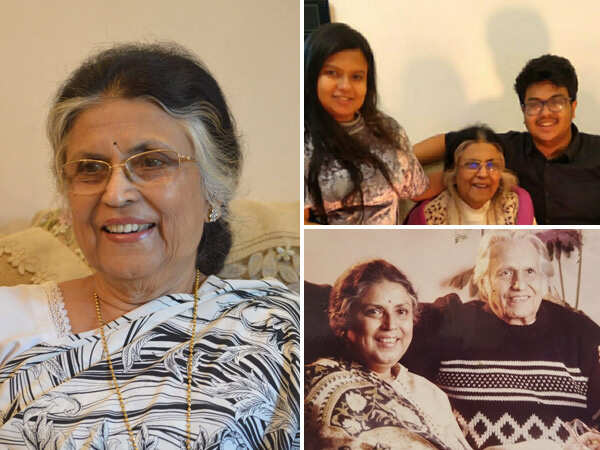
Suman Kalyanpur, a gifted singer who made a mark with songs like Na na karte pyar tumhi se (Jab Jab Phool Khile), Aaj kal tere mere pyar ke charche (Brahmachari) and many more, passed away in Mumbai at the age of 89. She used to be referred to as Lata Mangeshkar’s rival and just as gifted a singer. In this interview from 2025, Suman Kalyanpur spoke to Filmfare about her life, career and controversies. You can read through her last interview to discover a singer par excellence and an equally beautiful human being. Read on:
There’s a nip in the air and she has a slight cough. She gestures her daughter Charul to get her a glass of warm water before we begin. “I could eat khatta and teekha those days. But I didn’t touch ice-cream till the ‘80s. I enjoy it today,” she smiles her dimples wiping away the years. What she also enjoys is doing her daily ‘ibadat’ (worship), her knitting and crochet sessions and culinary adventures. She even shows me a muffler she’s knitting for her granddaughter. Never a part of the cutthroat trail, she seems content to retire to this life of small joys…
Did you know that the impish Aaj kal tere mere pyaar ke charche (Brahmachari), the flirty Na na karte pyaar tumhi se kar baithe (Jab Jab Phool Khilein), the sad Bujha diye hain (Shagun) and the soulful Allah karam karna (Dada) were not sung by Lata Mangeshkar but by Suman Kalyanpur? Well most of us didn’t. Call it a boon; call it a bane, but Suman’s sweet and high-pitched renditions almost always got mistaken for the Nightingale’s. In fact, so honey-soaked was her voice that she was once viewed as a serious threat to Lata’s monopoly during the ‘60s. But for Suman, who will be celebrating her 74th birthday this month, Lata remains her idol. “Lata Tai’s birthday falls on September 28 and mine on January 28,” she beams proudly at the commonality.
It was destiny that made her swap the paint brush with the microphone. A student of JJ School of Art in the ’50s, she used to sing at college functions. “A neighbour taught me how to use the tanpura and introduced me to sargam,” she recalls. “Then I started attending a light music class. Yashwant Deo, our teacher, composed Marathi songs. He made me sing in a Marathi film. I was just 16.” Later, Shahid Latif gave her a song in Darwaza. But her big break came with the number Meri preet meraa pyaar (Tirth Yatra). “While I was still in the second year of college, I had developed an allergy to turpentine. It made it difficult to paint. On the other hand, my music career had taken off. Yahi meri manzil thi (this was my destination),” she explains. She then went on to cut records with composers including Naushad, Madan Mohan, Shankar-Jaikishan, Kalyanji-Anandji and Laxmikant-Pyarelal right up to Anu Malik and Bappi Lahiri. Her last hit was Zindagi imtihan leti hai (Naseeb) in the ’80s.
MY HUSBAND, MY FAN
She cherishes the support her businessman husband, the late Ramanand Kalyanpur, gave her. “He was my biggest fan. He’d remind me to do riyaz. When I’d be rehearsing he’d come quietly and listen. He’d say which harkat (note) was good. I never went for any recording without him. He was my encyclopaedia. He knew all my songs, the name of the films and when they were recorded. He’d refer to my song as ‘hamara gaana’.” She adds, “We lived in a joint family of 17 people. He’d prepare the morning tea and even help me cook if I had to sit for riyaz.” Then glancing affectionately at her daughter she says, “I wonder how I managed it all. I had a house to run and a daughter to look after. But she was not a demanding child. She’d never trouble me. She’d ask her father if she needed anything.”
THE WORLD’S A STAGE
It was Suman who pioneered the trend of holding concerts abroad (1969-76). She held them across 32 cities in the US, Canada, England and the West Indies. One memorable show was the one, which coincided with the moon landing on July 19, 1969 in New York. “Because of the historic moment, which was to be aired on TV that night, the technicians didn’t arrive to set the stage. But luckily, a neighbour, an engineer there, helped us make the arrangements. I was surprised to see the number of Indian students who had turned up. When I sang Juhi ki kali meri laadli (Dil Ek Mandir), they asked for an encore. They said that they could catch the repeat telecast of the moon landing but not my show.” There’s a story behind why she stopped doing concerts after 1976. “While we were travelling for a show in Canada, my mother passed away back in India. My husband being very professional didn’t want the organisers to suffer losses. So the news of her death was kept away from me. I got to know about it on my return. I was so upset that I gave up shows totally and even singing for a while.”
DUET DELIGHTS
Coming back to her career, she was very particular about the picturisation of her songs and stayed away from raunchy jigs. “Hamein suron mein acting karni padhti hai (we singers have to act through the notes),” she says of how emotions were integral to a song. She was considered ‘lucky’ for duets having sung most of them with Mohammed Rafi, Mukesh, Kishore Kumar and Manna Dey. “They’d do the mahurat shot with my songs. They thought it was lucky for the film. Manmohan Desai did it a couple of times. Even the song Allah tu reham karna was used as the mahurat shot for Dada,” says the singer adding, “Today songs are sung on track and most often the singers never meet. But it was not so then. Rafi saab and I were not great talkers. We usually kept to ourselves. But Manna Dey was a jovial and kept us in splits.” She continues, “Roshan saab’s wife taught me to make omelettes. Though I’m a vegetarian, she insisted I learn it for my husband. Also Jaikishenji had promised that he’d give me at least one song in all his films and he kept up that promise.” She rues the fact that while she had rehearsed for a number with the late Madan Mohan, it never got recorded. “The song is even written in my diary.”

LATA TAI AND ME
That brings us to Lata, who was Madan Mohan’s muse. “She was my idol. When I was 13, I remember deliberately passing her house at Nana Chowk with my friends to catch a glimpse of her. When I recorded my earliest number, the lorie (lullaby) Ankhon ke taare (Mangu) for Mohammed Shafi, she was present in the studio. I was excited and my heart was beating fast. She encouraged me,” she narrates. “Often she’d go out of the way to drop me back home.” Incidentally, Lata and Suman even sang the duet Kabhi aaj kabhi kal in Shart. To the uncanny similarity in their voices she says, “Hum log Saraswati (Goddess of learning) ke paas saath gaye honge (We must have gone to Saraswati together). She must have given prasad to us both.” There’s one more similarity I remind her. Both never sang for O P Nayyar. “I had begun rehearsing for one song with him….,” she says leaving the sentence midway.
MONOPLOY OR MYTH
When asked about the allegations of career sabotage by the Mangeshkars, Suman who was recently conferred with the Lata Mangeshkar award by the Maharashtra Government refuses to comment saying, “Whenever Lata Tai and I meet, we are like long lost friends.” Without taking any names she however says softly, “We really don’t know what happened behind the scenes. There have been times when my songs were dropped from films but I do not know how and why. Sometimes the songs which I recorded were not included in the film. Sometimes they were in the film but not in the records. My husband kept all this from me. But when my daughter grew up she began to feel hurt.” She continues, “I felt it was futile working so hard. There was no sense continuing.” More recently, her songs were not included in a compilation of the best music in Indian cinema, which had even Dilraj Kaur and Sharda’s numbers. “Often I was not credited for a song played on radio or a wrong name was given for a song sung by me. Also someone else’s name was given in the credits on the records that I had sung. It can’t be a mistake every time. There was a beautiful, slow lorie I had sung for a movie. But I was surprised to hear it in double speed on an EP.” Yet her voice betrays absolutely no rancour. “I’m happy with the songs I got. Even from the 10 per cent I got, 70 per cent have been hits. That gives me satisfaction. Saraswati Maa gave me kanth (voice) which I put to good use; I gave anand (joy) and that’s my punya (good deed). What I didn’t get was not in my destiny. I’ve no regrets.”
ALso Read: Veteran Singer Suman Kalyanpur Passes Away at 89




 By
By