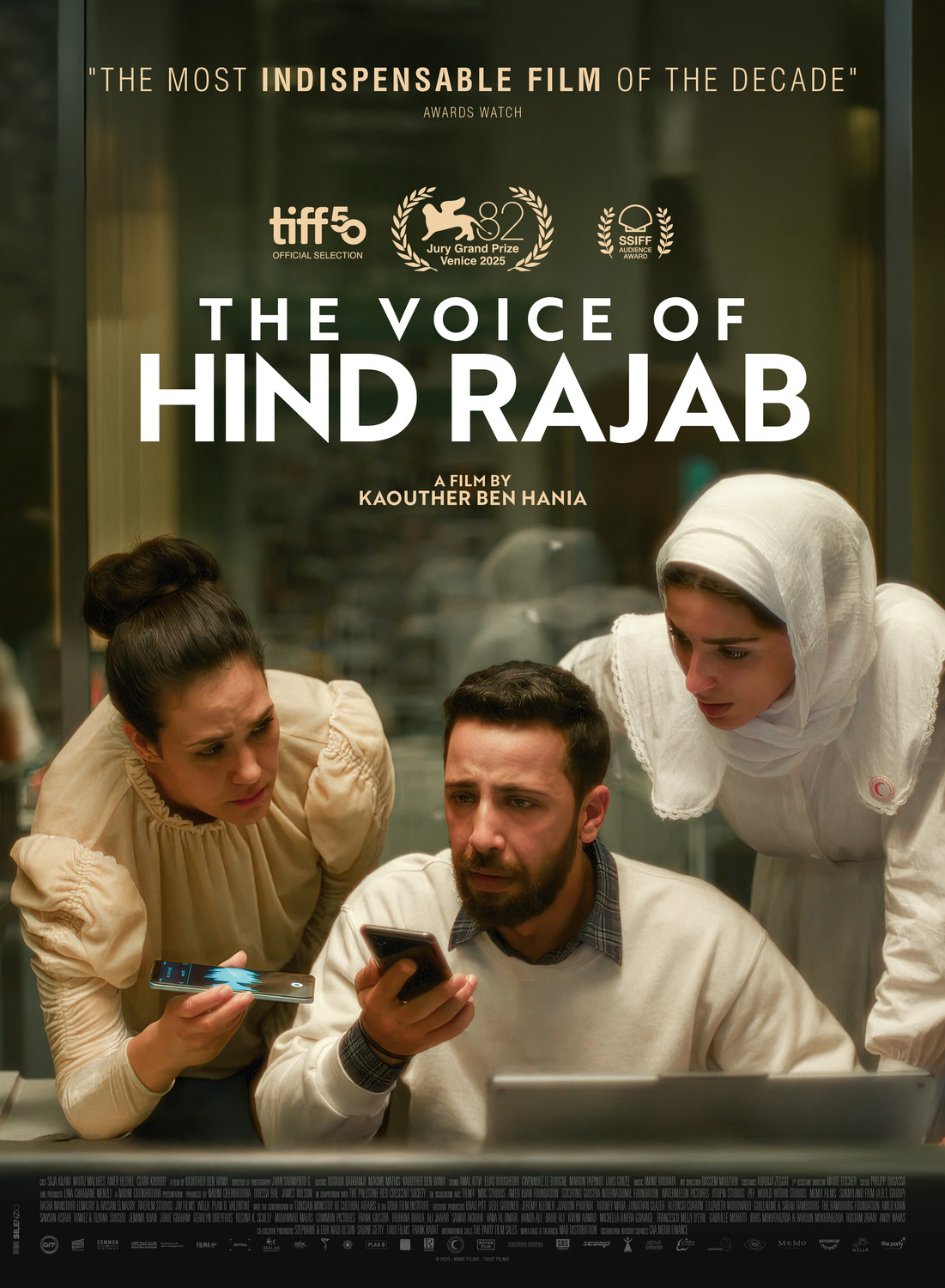

Kaouther Ben Hania’s poignant tale of the tragic story of a 5-year-old Palestinian girl shakes your soul and breaks your heart, because, like Hind Rajab’s, thousands of other innocent voices have been silenced.
Rating:  ( 5 / 5)

By Mayur Lookhar
At last, we have heard The Voice of Hind Rajab (2025). Initially snubbed by the CBFC (Central Board of Film Certification), which cited Section 5B (1) of the Cinematograph Act, 1962 – a guideline stating that a film may not be certified for public exhibition if it impacts friendly relations with foreign states – the Oscar-nominated Tunisian film finally arrived in India last week. Though it was later cleared by a review committee, following an uproar and demands from several politicians, The Voice of Hind Rajab still received barely any screens. The poor Indian distributor did not even hold a press show, as we were told. We travelled all the way to South Mumbai to watch the acclaimed film.
Tunisian filmmaker Kaouther Ben Hania’s docudrama recounts the tragic story of Hind Rajab, a 5-year-old Palestinian girl who was killed along with family members by Israeli Défense Forces tank fire on January 29, 2024. The alleged culprits have been identified as Colonel/Lt. Col. Beni Aharon (401st Armored Brigade Commander), Lt. Col. Daniel Ella (52nd Armored Battalion Commander), Major Sean Glass (Vampire Empire Company Commander), and tank crew member Itay Cukierkopf.
Finally, we got a sense of what this poor little girl went through in the final hours of her life. There are no visuals, only real audio recordings, but the tragedy plays out in your mind. What hurts even more is the lingering thought that she may have been saved – or maybe not. Pardon our cynicism, but the massacre in Gaza has been unimaginable.
As of 3 May 2026, at least 75,811 people (73,770+ Palestinians and 2,039+ Israelis) had reportedly been killed in the Gaza war, according to the Gaza Health Ministry (GHM) and the Israeli Ministry of Foreign Affairs. This tragic list includes some 270 journalists and media workers. The death toll among children is said to be above 20,000. Little lives reduced to numbers.
While the terror inflicted on 7 October 2023 must be unequivocally condemned, can there be any justification for the killing of over 20,000 children in Gaza? Decades of rift, multiple conflicts, and mass casualties and yet it is always children and women who suffer the most.

Ben Hania stays clear of history and politics, and, quite frankly, the “Free Palestine” or “Am Yisrael Chai” sloganeering from the rest of the world does little to save innocent lives. As neutrals, can’t the world simply appeal for an end to this mindless massacre of civilians? Ben Hania’s endeavour here is solely to apprise the world of what transpired on that ill-fated day. To the world, Hind Rajab did not exist before 29 January, 2024. Sadly, she does now, in spirit. Just look at the picture of the little girl and you are left wondering what kind of people do not flinch at killing children.

Sadly, most of the world never saw Hind Rajab; it was only through her voice that we came to understand the weight of her plight. What is most striking is how a child so young, trapped inside that car for hours, still found the strength to respond to the Palestine Red Crescent Society. And when Rana gently says her relatives are sleeping, the child’s answer – “No, they are dead” – lands with devastating clarity, revealing a child forced to confront death far too early.
It also speaks to the larger reality of childhood in Palestine, where grief shadows even the most innocent moments. We still remember the image of Palestinian children playing with a doll and enacting a funeral – a scene that stayed with us because it said so much about the life they are forced to live.
Hind Rajab communicated with responders from the Palestine Red Crescent Society, chiefly Rana Hassan Faqih (Saja Kilani), Omar A Alqam (Motaz Malhees), and later Nisreen Jeries Qawas (Clara Khoury). She repeatedly urged them to come and save her, take her home. Hania’s use of Hind’s real audio recordings makes the experience emotionally devastating for the actors, who know very well that their response to Hind’s SOS cannot undo the tragedy.

How does one act in a film like this? The cast breaks down on screen, and one can only imagine how many times they must have struggled to hold back tears while filming. The Palestine Red Crescent Society is a humanitarian organisation working tirelessly to rescue civilians caught or deliberately targeted in the conflict, yet here it is the responders themselves who seem to need counselling when they are unable to save innocent lives. The scene in which Rana breaks down and is consoled by Nisreen is especially heart-breaking. In another moving image, Hania chooses to play actual footage of the real Nisreen and Omar during their final communication, shown through a mobile screen, with the actors enacting the same scene in the background.
For Omar, the greatest frustration is that help was only 8–10 minutes away, and yet for nearly three hours, he watched helplessly as his senior, Mahdi, battled bureaucracy to secure a green signal and a safe route from the mandarins in Jerusalem and Ramallah. Like Omar, you may find yourself frustrated, wanting to cry out: “Forget the protocol, just send someone quickly to save Hind.” By the end of the film, though, you feel for Mahdi (Amer Hlehel), because he was only doing his duty.
Ben Hania’s actors do not merely perform; these scenes feel lived rather than acted. You simply cannot take your eyes off Kilani and Malhees.
95 minutes later, a stunned silence filled the movie hall. Some burqa-clad women were left inconsolable. For this reviewer, the experience was deeply numbing, with the brutality and inhumanity of the war proving almost too difficult to absorb. India, once respected for its neutral and moral stance on global conflicts, has instead seen its current mandarins remain silent on the massacre in Gaza. Desi propagandists, meanwhile, have cheered on the regime in Tel Aviv. Recently, an Indian seafarer lost his life in a US-led attack on a merchant ship, while social media buzzed with claims that his father had previously called for ethnic cleansing in Gaza. One can only hope that this personal tragedy leads to reflection and change.
As for CBFC, it defies belief how the Examining Committee feared this film could impact India-Israel relations. We leave the politics to politicians, armies, but we were intrigued by a dialogue in the film where Omar or Mahdi reveal that heat sensors help detect human life in conflict zones. Surely, the Israeli Tank Fire sensed life in Hind’s car. Instead, those inhuman soldiers fired 335 bullets into the car.
Following the terror attacks of 7 October, there were rumours in Israel that Hamas had killed children, with some even being put into microwaves. They turned out to be false. Nevertheless, the kidnapping and mindless killing of innocents by Hamas on 7 October ought to be condemned. If that is terror, then the revenge killing of over 20,000 children in Gaza, many reportedly shot in the head by IDF snipers, is terror in its most grotesque form. This is genocide.
Recent reports suggest that one of Hind’s killers was killed in a strike by Hezbollah in Lebanon. You may feel for his family, but he met his karma. While many in Palestine, the Middle East, and around the world celebrate the Israeli commander’s death, this will not bring back the countless Hind Rajabs. It is painful to see what this conflict has become, where human beings have no qualms about inflicting pain on fellow human beings, especially children.
This conflict has also helped us realise that many Israelis, including Israeli soldiers, come to India for healing. What if some of them were Hind Rajab’s killers? We wonder how they would react to The Voice of Hind Rajab after all that healing. One can only hope there is remorse. If we Indians can heal, why are we so powerless to stop these brutal wars in the first place? Well, that is simply out of our hands, but India can provide some healing to displaced Gazans by lending an ear to the distress call from the Palestine Embassy in India. This film is not about accolades or 5-star ratings, because they won’t bring back the dead. Ben Hania’s film is a humble plea for the world to no longer remain a silent spectator to the cries of thousands of Hind Rajabs.


 By
By