
 Quick Take: Ravi Teja’s restrained performance and a lived-in father-daughter bond elevate the drama.
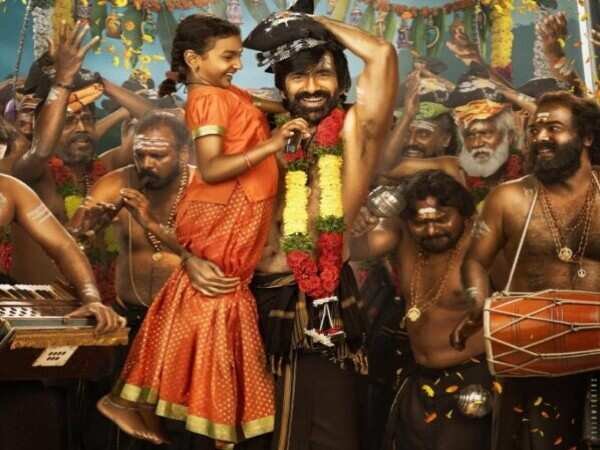
In the Telugu village of Polluru, Trinadh is a devoted but flawed family man whose world revolves around his young daughter, Manikantha. Every year, he observes the rigorous 41-day Ayyappa Deeksha, during which he abstains from violence and alcohol. But his path to spiritual devotion is shattered when the village is gripped by a chilling series of abductions and murders targeting young schoolgirls. As fear tightens its hold on the community, Trinadh is forced to abandon the sanctity of his vow and confront a darkness he never imagined.
Director Shiva Nirvana lets Trinadh’s emotions do the heavy lifting. When he crosses lines through deception, violence or breaking his vow, the writing allows the audience to feel the cost rather than simply chase catharsis. That is what elevates Irumudi beyond a conventional revenge thriller and makes it something more human. The stretch where Trinadh declares his message of mercy is particularly effective. It builds a sense of edginess without the hero having to spill a single drop of blood. The combat sequences are high-voltage without resorting to mindless bloodletting, while the scenes set in the school create a palpable sense of darkness.
Trinadh’s faith in God is not performative, but the film could have explored more deeply how his devotion shapes his moral outlook and the choices he makes. Usually, revenge thrillers resort to the angry-goddess trope. Irumudi, to its credit, attempts to deviate from that familiar template. A particularly nice exchange between the protagonist and Guru Swamy sees the latter argue that a girl child is better raised to fear everyone. Since Trinadh’s upbringing is rooted in a different ideology, the contrast between their worldviews adds weight to the scene. The film also uses a major character as a red herring, while a few momentous incidents in another crucial character’s life unfold in a particular manner because Trinadh is occupied elsewhere.
However, the pre-interval conversation between the father and daughter could have been more elaborate. Trinadh also finds himself in the danger zone too often, largely because of his tendency to pick fights. The incidents following a shattering tragedy in the village should have been more disturbing and heart-rending. One primary character does not quite come across as someone undergoing a truly harrowing experience, while the trajectories of most of the negative characters remain predictable.
In his 2000s films, Ravi Teja delivered performances that carried considerable tonal weight. During the 2010s, filmmakers often struggled to recreate that persona. After a long time, Irumudi allows him to deliver a studied portrayal of a character whose identity is built around rage, restraint, affection and devotion. His father-daughter relationship with Manikantha feels lived-in rather than performed. Baby Nakshathra, as Trinadh’s daughter, suits the part well. Sai Kumar, as the protagonist’s family friend Guru Swamy Goparaju, could have been more dramatic in a crucial second-half scene. Swasika Vijay, as a sinister schoolteacher, makes her villainy quite obvious. Ajay Ghosh, as Trinadh’s rival in the village, is as good as Ramesh Indira, who plays a fairly run-of-the-mill evil politician. Priya Bhavani Shankar plays Trinadh’s spouse.
GV Prakash Kumar’s background score imbues the film with the energy of a revenge thriller. The songs Mallepoola Pallaki and Irumudi Kattu are designed not only to amplify the devotional quotient but also to add another layer to Trinadh’s otherwise heroic father figure. Vishnu Sharma’s cinematography complements the film’s slow-burn desperation and grounded intensity.
To encapsulate, Irumudi is a solid, intense drama elevated by Ravi Teja’s restrained performance and a convincing father-daughter bond. But predictable villains and uneven emotional beats prevent it from becoming as powerful or shattering as it could have been.
Also Read: Toxic English Trailer: Yash’s Dubbing, Team’s Efforts Earn Praise


 By
By




 By
By