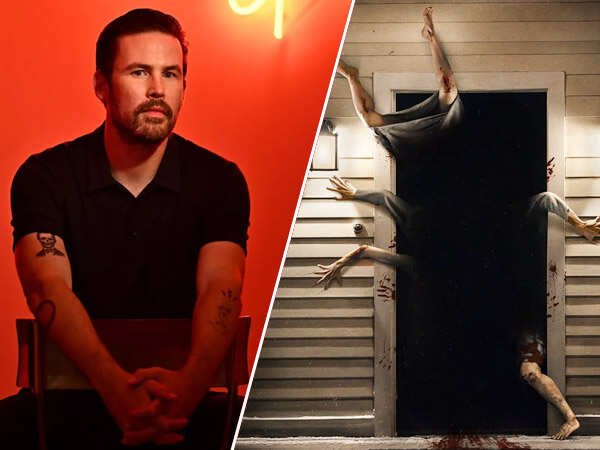


Inspired by the iconic video game series, Cregger’s new film takes the mayhem to the next level with a fresh, standalone story set in the Resident Evil world – no homework required for those unfamiliar with the franchise.
Getting his start in sketch comedy (Whitest Kids U’ Know) and sitcoms (Wrecked), Cregger made an unlikely pivot to horror with his stylized 2022 hit, Barbarian. His follow-up, the supernatural mystery Weapons (2025), solidified his place among Hollywood’s top directors, with a $270 million box office haul and an Oscar for Amy Madigan’s turn as Aunt Gladys. Cregger talks about the new Resident Evil movie from Los Angeles. Excerpts:
For anyone unfamiliar with Resident Evil, what’s the elevator pitch?
What made you want to get involved with this franchise?
I’ve played these games for decades. Resident Evil is the flagship of survival-horror. They’re about slow, deliberate, dread-filled pacing: you have a gun with two bullets, you’re walking down a dark hallway, and you know you’re outnumbered. They’re authentic and realistic despite the fantastical elements, and inherently cinematic. I wanted to make a movie authentic to that tone.
You wrote this before Weapons, without intending to direct it.
I did. At the time I’d only made Barbarian, so I wrote it in a very carefree way. But by the time I finished, I knew I wanted to be the one to make it m, so I pushed for it.

Unlike Barbarian and Weapons, I didn’t want narrative trickery here. The challenge was telling a simple, linear story. Our big event happens around minute six or seven, and from there it’s pedal to the metal until the movie ends. I hope it plays like a rollercoaster that doesn’t let up.
Tell us about casting Austin Abrams as the lead.
Austin and I had such a great time making Weapons together. He has this unassuming, everyman quality. He’s athletic but not an athlete, with zero combat experience, and you can tell just by looking at him. That’s an asset. I wanted this to feel like, ‘What if Marty McFly was thrust into a horror pit fight?’ He was perfect for it.
A lot of people didn’t instantly recognize him in the Resident Evil trailer, especially not as the lead from your last film.
Austin is a committed, borderline method actor. For Weapons he lost a lot of weight to play a drug addict. For Resident Evil he went the opposite way. He packed on pounds to be more of a cuddly teddy bear. He’s unrecognizable.
Tell us about the supporting cast.
It’s a limited cast really, the engine of the film is Austin facing off against different bespoke threats. But we do have interludes: Paul Walter Hauser (Black Bird) plays an Umbrella Corporation employee who sheds light on Austin’s mission, Kali Reis (True Detective: Night Country) has a brief but memorable stint, and there are some familiar faces near the end.
How did you bring the visual language of the games into the film?
Games use a visual vocabulary that’s utilitarian yet inherently cinematic. A camera that’s fluid, yet locked to the protagonist. If Austin looks right, the camera has to keep him framed while swinging around to catch what he’s looking at; if he looks up, we drop down with him. It’s tight choreography between camera operator and actor. That toggling between first-person and over-the-shoulder third-person isn’t just a gimmick – it keeps us locked into Austin’s perspective, so when things pop off, we’re that much more invested.
Have you done anything like that before?
A little in Barbarian, and Weapons got more subjective too, following people from behind. But I went much harder here. Son of Saul (László Nemes, 2015), set in a concentration camp, really opened my eyes to the potential of hyper-subjective cinematography.
Was the film designed or shot with IMAX in mind?
It was! You have to account for the aspect ratio while filming. I’m thrilled to show it in IMAX, especially with audiences primed after The Odyssey used the format so well.
Is there a practical-effects sequence you’re excited to share?
Every director wants to go as practical as possible. It just feels more authentic, even when you have to augment with VFX. There’s one sequence I’m especially proud of: Austin running down a street as zombies leap off six-story rooftops on either side of him. Rather than do it all in VFX, we rigged cranes with 150-pound blood bags, rehearsing the timing so they’d detonate against the cars around him as he ran through. We did some VFX sweetening for the blood splatter, but the physics is real, with real explosions, real hits, dropping all over the street.

The whole movie takes place over one snowy night. I didn’t realize how demanding that schedule would be. Setting your alarm for 3PM, shooting all night, bed by 7AM, not seeing the sun for months. That was hard.
Are there any Easter eggs for fans to discover?
They’re all over the place, some I wouldn’t even think of as Easter eggs. The padlocks and the search for keys and keycards from the games are baked into the movie, along with healing items, ammunition, and weapon progression, all the DNA of the games.
You started in comedy. How do those instincts play into horror?
It comes through subconsciously. The anatomy of a joke and the anatomy of a scare are very similar. Both use timing and tone to lead people to expect one thing, then subvert it. Making comedy works the exact same muscle as writing horror.
What projects do you have coming up?
I’m working on a Weapons prequel, Gladys, with Zach Shields (Godzilla x Kong). I’m producing and writing Siren Head, which Brian Duffield (No One Will Save You) is attached to direct. And next I’ll be shooting Flood, a sci-fi movie, hopefully next summer.
What do you hope audiences take away from Resident Evil?
It’s a love letter to the games, but first and foremost it should be a blast. It’s scary, funny, and a breakneck 90-minute sprint. It’s the kind of movie I wish was made more often; there were more like it in the late 80s and early 90s, but they’re rare now. I’m really proud of it.
Also Read: All Pictures of Salman Khan and his Family from Ganpati Visarjan


 By
By



 By
By