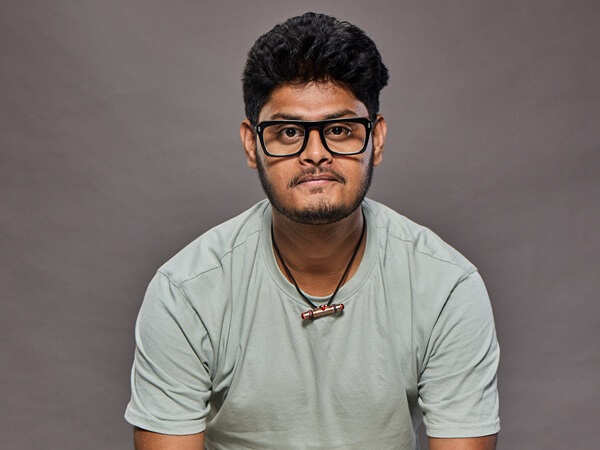

 The idea for Jerax didn’t arrive in a writer’s room. It came from a neighbourhood Xerox shop. For filmmaker Srinidhi Bengaluru, it was just another visit, the kind that rarely leaves an impression. But somewhere in that routine, a thought began to take shape and refused to leave. What if human beings could be duplicated the way paper is?
“At that point, it wasn’t a story yet,” he says. “I was at a Xerox shop near my house, and suddenly I thought, what if we could duplicate human beings the way we duplicate paper? That one idea stayed with me.”
After the success of his debut film Blink, which won him the Filmfare Award for Best Film (Critics’) in 2024, Srinidhi was already looking for something that would move differently. The thought, as strange as it sounded, gave him a way in.
From Idea To World
What followed wasn’t a direct move into writing, but a gradual process of building outward from that initial thought. Instead of locking into a plot immediately, Srinidhi began with the character, trying to understand who this person was before placing him in a situation he could not fully control.
“At that point, it wasn’t even a proper script,” he explains. “I started with a character; his desires, his age, his world. I built everything around him first. Then I explored how this idea of duplication would affect him. Initially, I wanted to make it a crime thriller. A man gets this ability and uses it to commit crimes. That was the first direction.”
Even as the tone was still evolving, the setting became a clearer decision. He chose the Madhugiri–Pavagada region near Tumakuru, not as a spectacle-driven backdrop, but as a space that felt lived-in and specific.
“It’s a very unique region, culturally different, with people from multiple linguistic backgrounds. I felt it was less explored, so placing a fantasy story there made it more interesting for me,” he says.
The Idea That Almost Fell Away
Like many ideas that don’t immediately find their place, Jerax went through a period where it stalled. Early reactions suggested that the concept might not connect with a wider audience, and for a while, Srinidhi stepped away from it.
That distance came less from doubt and more from uncertainty about where the idea belonged. Without the right format or context, it remained something he returned to occasionally, without pushing it forward. The turning point came when the possibility of developing a web series emerged.
“I didn’t write a full script at that stage,” he says. “I recorded a six-minute audio version of the story with sound effects and music, almost like a small audiobook. That’s what I presented. After a few months, they came back and said the idea was interesting and we could develop it.”
The shift in format allowed the idea to be approached differently, not just in terms of structure, but also in how it could unfold over time, eventually taking shape as a ZEE5 original backed by actor-producer Daali Dhananjaya.
Shifting The Tone
The most significant change came in the tone of the narrative. What had initially been conceived as a crime-driven story began to move towards something lighter and more accessible.
“After Blink, I realised something important,” he says. “It was appreciated critically, but it didn’t reach a mass audience. I felt there was a gap. We are lacking entertainment in Kannada cinema right now. So I thought, instead of making this very serious, I should go towards a comedy of errors.”
That shift changed what the story was really about. Instead of focusing on the mechanics of the power, the narrative began to revolve around the person holding it; and more importantly, his inability to fully understand it.
“I liked the contrast,” Srinidhi says. “What happens if you give a superpower to someone who doesn’t know how to use it? Prakash is not a hero. He’s just a Xerox shop worker. He’s not even the owner. He has his own struggles, his own love life, and he’s a bit of a failure. Giving that kind of person a power like this makes it more interesting.”
Where The Chaos Kicks In
From there, the story builds through consequence rather than spectacle. The duplication ability is not treated as something to be marvelled at, but as something that gradually complicates the character’s life.
“Once he understands the power, he starts using it for his own benefit,” he explains. “And then things start going wrong. That’s where the fun is. It becomes about situations, confusion, and how he deals with it.”
The humour comes from that gap between intention and outcome—small, personal decisions spiralling into something far messier than expected. Beneath that, the idea also leans into questions of identity, what it means to exist alongside another version of yourself, even if the narrative doesn’t always push it to the front.
Cracking The Format
The move to a web series format introduced a different set of demands. Unlike a feature film, where the narrative can take its time to build, the episodic structure requires a more contained and precise approach.
“In a film, you can take your time to establish the world and characters,” he says. “Here, I didn’t have that luxury. Each episode runs for around twenty minutes, so within that, I have to introduce, build conflict, and reach a high point. Every episode needs a peak. That was the biggest challenge.”
Writing within that structure meant rethinking how the story moved from one beat to the next.
“I had to learn how web series work,” he adds. “Every episode has its own structure. There’s an introduction, a midpoint, and a kind of climax. And then there’s always something that pulls you into the next episode.”
Working Within Constraints
Production also unfolded within tight limits. The entire series was shot in just over three weeks, which meant that decisions had to be made quickly and often without the option of revisiting them.
“We had only around 22 days to shoot everything,” he says. “So it was very fast. Budget was also limited. But within those limitations, we tried to give the best possible output. That was our focus.”
Grounding The Fantastic
At the core of Srinidhi’s approach is an attempt to balance high-concept ideas with a sense of familiarity. Having grown up watching Kannada films before discovering world cinema, he approaches storytelling as a way of bringing those influences together.
“I’ve watched a lot of rooted Kannada films from my childhood,” he says. “Then later I started watching world cinema. So I try to combine both. Even if I take a high concept, I place it in a local setting, with local people, local behaviour. That makes it more relatable.”
That approach extends to how fantasy itself is handled. “People use technology without fully understanding it,” he says. “I treat fantasy in a similar way. It should feel simple to use, even if the idea behind it is complex.”
Looking Ahead
With Jerax set to begin streaming on ZEE5 from April 24, Srinidhi is already looking ahead. His sophomore film Video is currently in post-production and is designed as a theatrical experience. At the same time, he is also looking to return to something more personal.
“I want to make something like a love letter to cinema,” he says. “A very rooted story, something inspired by the writing of Jayanth Kaikini, a Kannadiga poet, short story writer, and playwright.”
Also Read: Ram Charan’s Peddi Nears Completion; Fans Relieved After Latest Update

 By
By