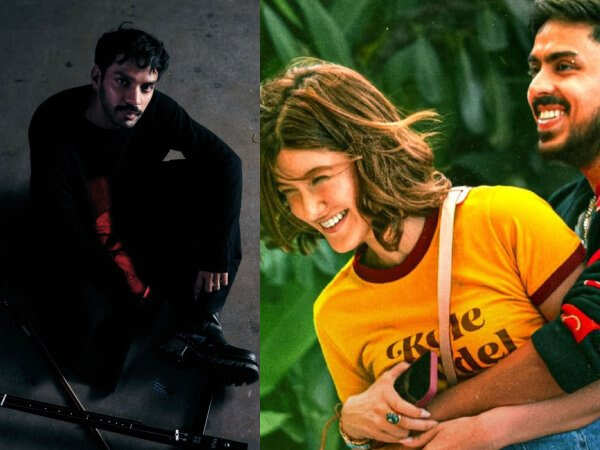


Music composer Prateek Rajagopal had not planned on debuting in Bollywood this soon, but a recommendation from his close friend and actor Adarsh Gourav changed everything.
Based in Los Angeles, the composer and producer has spent the last few years contributing to international projects such as The Mandalorian, Trolls Band Together, HIM and Eddington, collaborating with artists like Ludwig Göransson, Bobby Krlic, Lizzo and Eric André. This year, he made his Bollywood debut with Bejoy Nambiar’s Tu Yaa Main, starring Shanaya Kapoor and Adarsh Gourav. Born in Muscat and raised between Oman and India, Rajagopal started in India’s underground metal scene before moving into film scoring and formal training in the US.
That mix of backgrounds feeds into his work on Tu Yaa Main, where the score leans on analogue synths, orchestral elements and contemporary production. In this conversation, he talks about coming onto Bejoy’s film without a script, building its sound alongside the edit, and navigating two industries that approach filmmaking very differently.
How did Tu Yaa Main happen?
I came on board because of my friend Adarsh Gaurav. He recommended me to Bejoy Nambiar, and I got a message from him. Adarsh and I have been friends since college. We were studying business together and became good friends right off the bat due to our common interest in art and music. We also had a band together briefly. After that, we went our separate ways and then converged at some point. 13 years later, we are still really close friends.
If this hadn’t come through Adarsh, were you already planning to work on an Indian film?
I had no such plans because I’ve predominantly worked in Hollywood and have been there for the last six years. Because Adarsh and I are close, there was a lot of trust. That’s why I took this up. Eventually, I would have loved to work in Indian cinema, but I didn’t think it would happen this soon. It was a pleasant surprise.
What kind of brief did you get from Bejoy for TYM?
I barely had any information to begin with, and I didn’t even receive the script. Bejoy revealed things to me gradually. He told me it was a creature feature, but I didn’t know the first half was a rom-com. So instinctively, I began creating music for a high-octane, creature-feature thriller, which also paid homage to old school films. Bejoy wanted more of a retro sound initially.
As the process went on, he started giving me directions, and I began composing while he was still shooting. He would simply tell me what worked and what did not. At that time, I didn’t fully understand his feedback and kept wondering how it would all come together. But later, when he shared some footage with me, everything clicked, and I finally understood his vision.
Would you decode the film’s soundscape for us?
Bejoy wanted a lot of synthesisers, which is completely in my wheelhouse. I enjoy working with modular synthesisers. At some point, while working on the edit, he suggested adding strings. So we started with a synth-heavy base and then gradually introduced string instruments, which turned it into a hybrid score. I then approached my friends Isaac and Jose, who play a lot of string instruments. I asked them to create ideas and sound banks, and I then chopped and looped them the way you would with electronic music.
Slowly, we made it more cinematic. We added brass, big percussion, which I also ran through my electronics modules. It became a hybrid score with a very modern edge, but still paying homage to a sci-fi sound from the 70s and 80s. We also came up with a few themes for the crocodile. There’s one theme which plays on like a bell, a celeste. It’s a creepy horror motif. Another one is a synth theme gesture. It has four notes that keep repeating. And then there’s a percussion rhythm. So the combination of all of that gives you the feeling that the creature is lurking around.
What’s one thing the Indian film industry should understand better, and one thing Hollywood could learn from India?
Hollywood could learn from the sheer creativity here. There’s a huge emphasis there on technique; it’s a very technical market where people are constantly thinking about things like IMAX cameras and using those tools to tell stories, but also as part of a larger marketing machine. In India, everyone is inherently creative. You don’t necessarily go to school to study a craft; you just pick it up and start doing it.
Do you think composers today are moving beyond labels like Bollywood, Hollywood, and indie?
I agree. Initially, I only knew how to play riffs on the guitar. I did not know chords or harmony; I was doing it purely from instinct. Then I started to engineer and produce, and eventually went on to learn more formally. I did a master’s program alongside prodigious piano players, people who had been studying classical music since they were three years old. That’s where I picked up those skills, and now I can read music, direct an orchestra, and conduct. At the same time, I work with synthesisers, I know how to navigate that space, and I can write songs. I’ve worked on Hollywood songs with a lot of interesting artists, and I can also write indie music.
You were raised between India and Oman. How much did that difference in culture impact your outlook as a musician?
Oman was so beautiful, quiet, serene and peaceful. It was maybe too much for someone like me who likes to do a lot of things. I went the complete opposite way. I wanted to play metal guitar in this quiet place. The contrast is what I really enjoy in life. And Oman gave me that because who knows what kind of person I may be if I were born and raised in India. Geographical luck is a real thing. It informs you about your ethics, your ideas, vision, morals, identity, and musicality. Having lived in three different countries helped me a lot.
In Hollywood, did you ever feel the South Asian bias?
There’s definitely the South Asian lens that exists there, which I’m not the biggest proponent of. The stories told through that lens are very limited, largely because the diaspora has a very different experience of growing up there compared to the people here. So a lot of people do end up getting placed in that box.
I’ve been fortunate, though, to have worked with the mainstream Hollywood system with very few Indians. It’s always been people of white ethnicity, so I’ve managed to avoid being boxed in that way. The only time I would lean into projects for a desi audience is with work coming from here, because this is where those stories naturally expand from. This is the country of origin, so that’s how I see it.
What’s next?
There is another Indian project on the horizon. I’m also working on a VR project based in the State. Besides these, I have an album coming out with Emmy-winning artist Eric Andre.
Also Read: Tu Yaa Main Review: Survivor Horror Meets Class-divide Romance


 By
By