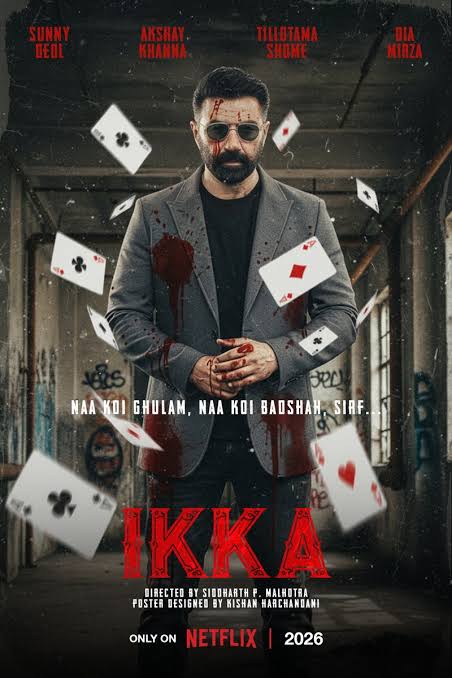

Writer Althea Kaushal and director Siddharth P. Malhotra’s film presents a unique dilemma for its leading protagonist, one that is likely to make or break this legal drama.
Rating: 
 (2.5 / 5)

By Mayur Lookhar
Given the state of affairs, there perhaps are more chances of a common man getting justice in Bollywood courts than in real ones. Filmmaker Siddharth P. Malhotra sought justice for the victims in his previous film, Maharaj (2024), a historical drama based on the Maharaj Libel Case of 1862. The quest for justice in his subsequent film, though, is trickier, given the predicament of its leading protagonist.
Story
Hailed as a vanguard of justice and a beacon of hope for victims, ace lawyer Advocate Arjun Mehra (Deol) stuns everyone by defending Shauryamann Gaur (Akshaye Khanna), who is accused of attempted murder, leaving the victim in a coma. The odds may be stacked against her, but public prosecutor Madhura Banerjee is determined to help the victim Shoma Mittal (Akansha Ranjan Kapoor) get justice. Is Shauryamann Gaur really guilty, or is he innocent?
Screenplay & Direction
The Ikka story is conceived and penned by Althea Kaushal, who has titles like Happy New Year (2014), Noor (2017), and the web series Mithya (2022) to her credit. Ikka comes across as a refreshing plot, mainly because of the dilemma faced by its protagonist. Arjun Mehra has his own personal reasons to defend Shauryamann, but it is this dilemma that is likely to make or break the film.
Maharaj and Ikka both seek justice for the victim(s). They are set in vastly different times and eras, and so too is the idea of justice. The former is set in the British Raj and mired in a faith-versus-state conflict, while Ikka harps on the familiar might-versus-meek conflict. The Lady of Justice is no longer blindfolded, and she no longer holds the sword. Perhaps Goddess Justitia, too, would welcome this change. We do not see Lady Justitia in Ikka, though. In Arjun Mehra’s opening scene, where he is delivering a talk at a law college, the statue of a human fist holding the scales of justice perhaps reflects our times, where the powerful hold all the aces.
Like Madhura, the viewer will feel that this courtroom drama is likely to end in a losing cause. The frustration here doesn’t stem from the plot but from an average screenplay that strikes as an interjunction between old-school Bollywood courtroom drama and modern-day realism. Each time a character resorts to melodrama, it is followed by a line meant to maintain decorum and realism. As the presiding justice in the film says, “No updesh (preaching)” Given that this is a direct-to-digital release, a more realistic approach might have been expected, but Maharaj was also an OTT release, and Malhotra likes sticking to his dramatic style. Where do you stand on this? To each its own.
Acting

The name Arjun has special significance in Sunny Deol’s career – Arjun (1985) and Arjun Pandit (1999). It is yet another Arjun character for Sunny Deol, but this one is a lawyer. Deol perhaps donned the cap for the first time since Damini (1993), where he is remembered more for his explosive dialoguebaazi than for Govind’s legal acumen. Ikka presents him as a strong but more professional lawyer. You are intrigued by Arjun’s opening lecture at the law college, where he says that the judiciary is just a medium for justice. Well, in a democracy, the judiciary is the only medium that grants justice. Once in court, Arjun Mehra defends his client with legal arguments rather than dialoguebaazi. Though defending a criminal, Arjun Mehra has no place for character assassination. He severely reprimands Shoma Mittal’s former boyfriend for speaking ill of her. Ironically, however, the same Mehra later does not shy away from generalising the youth.
For ages, a hero has been one who protects and delivers justice for the meek. In a complete turnaround from Damini, Deol now finds himself playing the Devil’s advocate. Arjun Mehra has his reasons. The intricacy of this legal conflict is such that more than one life is at stake here; any further word would be a reveal. Deol does well to rein in his famous temper, displaying it only occasionally. Well, when your counterpart is a woman, there’s no scope for needless aggression, and that is what makes this Deol performance more respectable. Mehra is fondly called Ikka for a reason, and he ultimately lives up to that reputation.

Deol is the star, but the ones who rack up aces here are Tillotama Shome and Akshaye Khanna. Remember Shome in The Night Manager, where she played a pregnant intelligence agent who takes on the might of an arms dealer in Shelly Rungta (Anil Kapoor). Lipika Saikia Rao, though, had a system to back her. Madhura Banerjee, however, is an underdog. She only enters the scene after the initial public prosecutor withdraws, citing health reasons. “Madhura, who?” is the instant reaction of many. On the first day of the proceedings, she slips on the stairs. Well, being unknown helps her, as there is no one to capture the moment. But once in court, she fights tooth and nail, taking even the much-fancied Arjun Mehra by surprise.
There is more to Madhura than just courtroom drama. Malhotra and Kaushal also delve into her personal life. That opening shot of Madhura shows a married woman on her window, drawing vegetables through a wired basket. This is reminiscent of Mumbai’s humble localities and of time management in a middle-class household. Her equation with her unemployed husband is not overplayed. When the critical moment in the case arrives, Banerjee does not wilt even when her husband is offered a lucrative job by Shauryamann’s powerful father. Is that the end of the relationship? Malhotra leaves that to the viewer’s imagination. Be it at home or in court, Madhura holds her own, with Shome delivering another compelling performance.

Then there is Akshaye Khanna, who will be seen on screen for the first time since Dhurandhar. It is a first reunion between Deol and Khanna since Border (1997). Given the mountain of expectations, an OTT release works well for Khanna, who may now settle into playing more grey characters. Born with a silver spoon in his mouth, Shauryamann is cocky to begin with. One has to pity the lawyer who has to defend such a spoilt brat. Over the course of the film, though, Khanna keeps you guessing, and may even make you lend an ear to Shauryamann’s side of the story. “I can make a mistake, but can’t commit a crime?” Shauryamann tells Arjun. Only Akshaye Khanna can deliver such talk with conviction. While Arjun Mehra holds the final aces as the devil’s advocate, it is Shome and Akshaye Khanna who help Ikka stay relevant and fairly engaging.
The rest of the cast simply appears to be filling up the numbers. Sanjeeda Shaikh, who plays Mrs. Gaur, initially feels wasted but makes a decent impression in the climax.
Technical Aspects
Courtroom dramas limit the scope for outdoor action. At 140 minutes, Ikka does not keep you hooked throughout. We spoke of Malhotra’s dramatic filmmaking style, but the filmmaker must rethink the overly dramatic BGM as well. There is relief in certain moments. The real cringe, however, is the witnesses’ and experts’ testimony, which sounds like bad commentary.
Final thoughts
Ikka had an intriguing plot, a talented lead cast, and the right cards, but director Siddharth P. Malhotra just didn’t play them right.
Video review below.

 By
By