

Kara is a film that reaches for an interiority its genre does not always support. It is structured as a character study, but one that intermittently slips into familiar dramatic territory. That push and pull defines the film, shaping both its strengths and its limitations.
Set in the early 1990s, Kara follows a small-time operator pulled into a high-risk heist that promises a way out of his circumstances. What begins as a calculated job gradually unravels, forcing him to confront both the consequences of his choices and the personal history he has tried to leave behind.
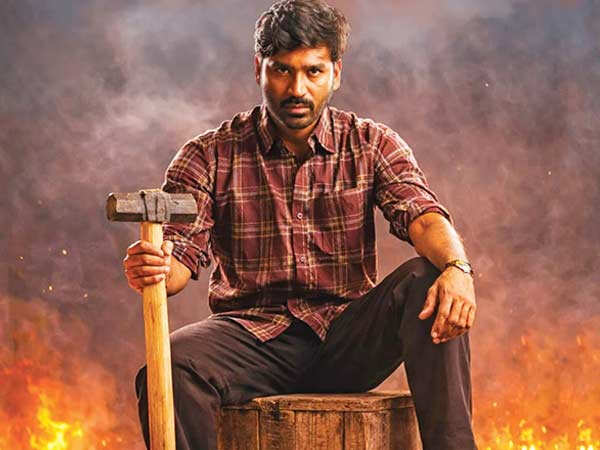
At the centre is Dhanush, who approaches the role with a restraint the film itself does not consistently maintain. His performance is calibrated around stillness. He uses pauses and minimal dialogue to communicate a layered emotional state. This becomes crucial in a film where the writing often withholds clarity without always replacing it with depth.
The supporting cast operates within a more limited frame, though not without impact. Mamitha Baiju brings a certain emotional directness to her role, even if the writing does not always give her enough space to develop beyond function. KS Ravikumar lends presence in a part that relies more on authority than depth, while Suraj Venjaramoodu adds texture in brief stretches, suggesting a complexity the film does not fully explore. Their performances register in moments, but the writing rarely allows them to exist independently of the protagonist’s arc.
The early portions remain the film’s most cohesive stretch. The director establishes tone through framing, silence, and spatial detail rather than exposition. The visual language contributes directly to the storytelling, reflecting the protagonist’s emotional detachment with consistency.
As the film progresses, that foundation begins to loosen. The screenplay introduces multiple thematic concerns, including guilt, identity, and moral compromise, but struggles to integrate them into a clear narrative progression. What initially reads as deliberate ambiguity begins to feel like a lack of consolidation.
This is most evident in the transitions. Key emotional and narrative shifts arrive without sufficient build-up, creating a sense of discontinuity. The film gestures towards complexity but stops short of articulating it with precision. As a result, several developments feel imposed rather than organic.
The tonal inconsistency becomes more pronounced in the second half. The film moves between a subdued, introspective mode and a more conventional dramatic framework without fully committing to either. The shift is visible in how narrative urgency begins to override the earlier emphasis on interiority.
Dhanush’s performance absorbs much of this instability. He maintains a clear emotional throughline even when the writing does not. There are stretches where the film depends almost entirely on his ability to hold attention, and he does so without overt signalling.
Technically, Kara remains solid. The cinematography favours composed, restrained imagery that aligns with the film’s tone. The background score supports rather than dictates emotion, while the sound design adds texture, especially in quieter passages. The editing, however, contributes to the uneven rhythm. Some sequences are effective in their brevity, while others linger without adding new information.
The approach to resolution further underlines the film’s imbalance. The latter portions move towards closure in a way that feels structurally necessary rather than emotionally inevitable. The climax attempts to reconcile the film’s ideas, but the execution lacks the gradual build required for a more resonant payoff. It resolves the narrative, but not fully the themes it introduces.
What remains is a film that works in parts. There are passages where Kara achieves the depth it aims for, particularly when it allows its quieter instincts to lead. But there are also stretches where the writing simplifies or rushes material that needed greater attention. The film’s strengths lie in performance and craft. Its limitations stem from writing that cannot consistently support its ambition. Kara engages with complex emotional material, even if unevenly. In the end, it settles into something less cohesive than it intends to be, held together to a significant extent by Dhanush.
Also Read: Dhanush’s Wunderbar Films Announces Production 20


 By
By