
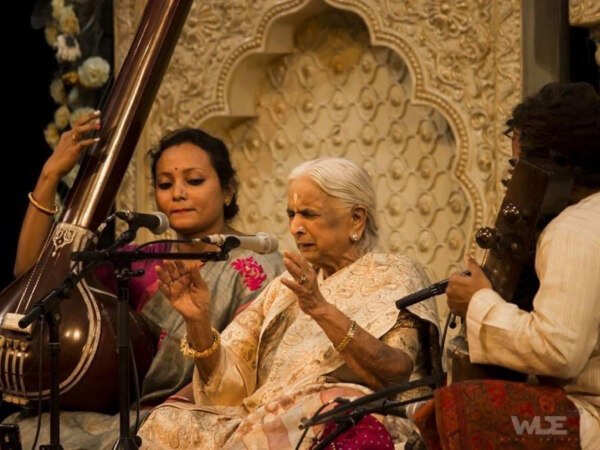

 On this day, as the morning light settles gently over Varanasi and the Ganga resumes her ancient, unbroken journey, one is reminded that some voices do not fade with time. They deepen. They gather meaning. They become part of the very air we breathe. Today marks the birth anniversary of Girija Devi, and to remember her is not merely to recall a musician, but to revisit a presence that altered the emotional landscape of Indian classical music.

She was not a voice that demanded attention. She was a voice that invited you inward. There was a stillness in her singing, an unspoken assurance that nothing needed to be hurried. In an age where performance often leans towards spectacle, Girija Devi belonged to a rarer tradition where music was an act of introspection. She did not sing to impress. She sang because the music existed within her and had to find its way out.
Born in 1929 in the culturally vibrant lanes of Kabir Chaura, her life was shaped early by an environment steeped in sound and silence in equal measure. Music was not introduced to her as a discipline. It was part of her surroundings, like the distant echo of temple chants or the rhythmic call of vendors in the street. Yet, what could have remained an incidental familiarity became a serious pursuit, thanks largely to the foresight of her father, Ramdev Rai. At a time when societal norms discouraged women from taking up music as a profession, he chose to nurture his daughter’s gift with unwavering conviction.
Under the guidance of Sarju Prasad Misra, Girija Devi underwent rigorous training. The discipline of khayal, the complexity of tappa, and the demands of classical grammar were instilled in her with precision. These were not easy years. Training was exacting, often unforgiving, and required a level of dedication that left little room for distraction. But what emerged from this period was a musician grounded in structure, capable of navigating even the most demanding compositions with clarity and control.

Yet, her artistic journey found its true direction in thumri. At the time, thumri was often misunderstood, placed in a secondary position within the hierarchy of classical forms. It was seen as lighter, less rigorous, and too closely associated with the world of courtesans. Girija Devi did not challenge these perceptions through argument or assertion. She transformed them through her music.
In her hands, thumri became expansive. It retained its lyrical quality, its emphasis on emotion, but it acquired a new dignity. She approached it with the same seriousness that one would bring to khayal, without stripping it of its inherent softness. Her singing was never indulgent. It was precise, thoughtful, and deeply expressive. Every note carried intention. Every phrase unfolded with care.
Her association with the Purab ang tradition gave her music a distinctive identity. This style, rooted in the cultural ethos of eastern Uttar Pradesh and Bihar, emphasises subtlety and emotional nuance. Girija Devi did not merely inherit this tradition. She embodied it. In her kajri, one could sense the arrival of the monsoon, not as a dramatic event but as a quiet transformation of mood. In her hori, there was joy, but it was never exaggerated. It felt lived, almost personal. In her chaiti, the expression of longing was so delicate that it seemed to exist just beneath the surface, never fully declared, yet unmistakably present.
What set her apart was her understanding of restraint. In music, as in life, she knew that what is left unsaid often carries the greatest weight. She did not overwhelm the listener with complexity. Instead, she drew them in, allowing them to discover the emotion within the composition at their own pace. It was a rare gift, and one that cannot be taught easily.
My own interactions with her, though limited, offered glimpses into this remarkable balance between simplicity and depth. Speaking to her over the phone, I was struck by how seamlessly her personality mirrored her music. There was no performative charm, no attempt to impress. She spoke with clarity, warmth, and a certain quiet authority that comes only from lived experience. When I mentioned my intention to meet her for an interview, she responded with a gentle humour, inviting me to her home and speaking fondly of her sarees and her paan. It was a small moment, but it revealed a great deal. She was deeply rooted in her traditions, yet entirely at ease within them.
Her peers recognised her stature not through formal accolades alone, but through genuine respect. Bismillah Khan, whose music carried the spirit of Banaras in its purest form, saw in her a kindred sensibility. Bhimsen Joshi admired the discipline and sincerity that defined her approach. Begum Akhtar, herself a legend of semi-classical music, shared with her an emotional depth that transcended stylistic boundaries. These were artists who did not offer praise lightly. Their regard for Girija Devi spoke volumes.
Her contributions were acknowledged with the country’s highest civilian honours, including the Padma Shri, the Padma Bhushan, and the Padma Vibhushan. Yet, it is evident that recognition was never her driving force. For her, music was not a means to an end. It was the end itself.
Beyond her performances, her role as a teacher remains one of her most enduring contributions. At the ITC Sangeet Research Academy and Banaras Hindu University, she mentored students with a dedication that went far beyond technical instruction. For her, teaching was about shaping a sensibility. It was about instilling respect for tradition while encouraging individuality. Disciples such as Sunanda Sharma and Malini Awasthi continue to carry forward her legacy, not by imitation, but by internalising the principles she embodied.
There are stories that continue to circulate among her students, stories that blur the line between reality and legend. It is said that when she sang Malhar, the skies would respond with rain. Whether one chooses to interpret this literally or metaphorically, it speaks to the profound impact her music had on those who experienced it. She did not merely perform ragas. She inhabited them.
In reflecting on her life, one is struck not by moments of dramatic transformation, but by a consistent, unwavering commitment to her art. There was no sudden rise, no calculated reinvention. Her journey was one of steady growth, built on discipline, patience, and an unshakeable belief in the value of what she was preserving.
Today, as we celebrate her birth anniversary, it is important to recognise what Girija Devi represents in a broader sense. She stands for a time when music was not fragmented into short, consumable pieces. It was allowed to unfold fully, demanding attention and rewarding it in equal measure. In a contemporary landscape where speed often takes precedence over depth, her music offers an alternative. It reminds us that true engagement requires time, and that the most meaningful experiences cannot be rushed.
And yet, she remains deeply relevant. Her ability to connect with listeners across generations lies in her authenticity. She did not dilute her art to make it accessible. She trusted the listener to meet her halfway. In doing so, she created a space where classical music could be experienced not as something distant or intimidating, but as something deeply human.
As I revisit my notes and memories, what stands out most is not any single performance or anecdote, but a feeling. A sense of calm, of clarity, of quiet confidence. Girija Devi did not need to assert her greatness. It was evident in the way she approached her music, in the way she carried herself, and in the way she influenced those around her.
Girija Devi may no longer be physically present, but her influence continues to resonate. It lives in the voices of her students, in the recordings that continue to inspire, and in the countless listeners who find in her music a sense of connection and meaning.
As the day unfolds and the light over Varanasi shifts from morning to evening, one is reminded that some legacies do not diminish with time. They expand. They become part of a larger continuum, shaping and enriching the cultural fabric in ways that are both visible and subtle.
Girija Devi’s music is not confined to the past. It exists in the present, and it will continue into the future. It flows, like the river she grew up beside, carrying with it the memory of what has been and the promise of what remains.
On her birth anniversary, we do not simply remember her. We return to her. Through her voice, we rediscover the depth of our own cultural inheritance. Through her music, we are reminded of the beauty that emerges when tradition is honoured with sincerity and carried forward with grace
Read Also:Shah Rukh Khan reveals if he personally replies to his fans on #AskSRK

 By
By