
Inspired by the folklore of Rajasthan’s Bullet Baba / Om Banna Temple, writer-director Ritwik Pareek ‘s black comedy is subtle take on the business of blind faith.
Rating: 
 (2.5 / 5)

By Mayur Lookhar
Leave aside the gods, but human worship is often down to a miracle – a legend claimed by one or two individuals. Seldom do people examine a folk legend through the eyes of science or logic. Well, in a nation that thrives on idol worship, it’s fraught with danger to question faith, more so blind faith. Writer-director Ritwik Pareek’s Dug Dug (2026) sheds light on one such legend. After travelling the festival circuit, the black comedy arrives in Indian theatres on 8 May.
Story
On a dark night in Rajasthan, a drunk man hits the highway on his Luna moped. After miraculously escaping it, he takes a left turn onto a deserted street, eventually falling off his moped. He is lucky to survive that fall, but before he can get back on his feet, lady luck runs out as he is run over by an unseen lorry. His body split in two, the man dies a horrible death. Nothing new in a nation often called the road accident capital of the world.
The mystery, though, arrives a day or two later when the moped miraculously ends up at the accident spot. If this was theft, then why would a thief drop the moped at that particular location? Worried chowki (beat) cops lock up the moped, but when it mysteriously lands at the accident spot two more times, a high priest is summoned, who believes that Thakur’s spirit isn’t at peace. Soon the accident spot is turned into a shrine, with the dead man and his Luna acquiring divine status.
Screenplay & Direction
Dug Dug is the sound of a two-wheeler when ignited. Buzz is that the film was completed in 2021 and, after travelling around the festival circuit for a few years, it finally makes it to Indian theatres this week. With the likes of Anurag Kashyap, Nikhil Advani, Vikramaditya Motwane, and Vasan Bala as presenters, it helps gain media spotlight but doesn’t necessarily brighten its box office prospects.

As a mark of respect to the deceased, real identities have been withheld, but this film is inspired by the legend of Bullet Baba. Sometime around 1988 or 1998, Om Singh Rathore, a Rajasthani man, was killed in a road accident on the Pali-Jodhpur highway. His death aroused curiosity because his Royal Enfield Bullet mysteriously reappeared at the accident site two or three times. Locals sensed something divine, and it didn’t take long for a shrine to be built there. After his death, Om Singh Rathore was revered as Bullet Baba, with locals and even visitors paying their respects at the Om Banna Temple.
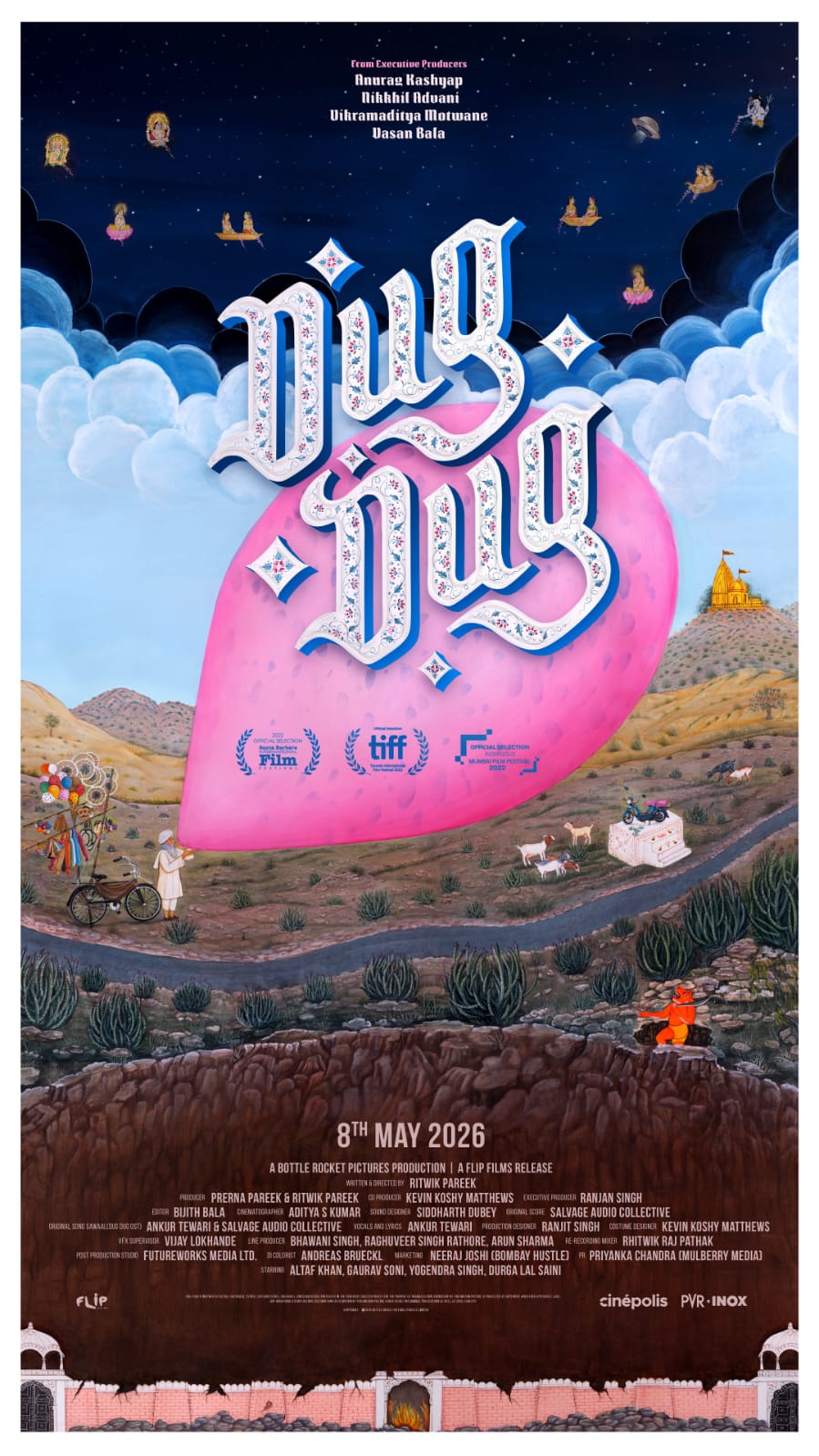
Based on the pictures available, the Om Banna temple appears to be a humble shrine, but films are meant to overplay, and Pareek turns the shrine into a gorgeous temple, painting Thakur Sa and his divine journey as fine arts. The subtle message, though, is how all it takes is a legend to drive the business of faith. Over here, blind faith.
It is all the more striking that locals attribute their personal and professional triumphs to Thakur Sa’s blessing. When he was alive, he was dismissed as an alcoholic and a smoker, but in death, the same people now offer liquor to appease his departed soul.
There is the shrine, the regular believers, and the tamasha around it, where everyone – from a humble balloon seller or shepherd to the local politician, the Rajasaab, and businessmen – seems to be exploiting the legend of the Luna.
No disrespect to the faithful, but such a ‘Luna’ tale is likely to amuse a logical viewer. The added theatrics are amusing at first, but thereafter the screenplay seems to run in a loop.
Even at 105 minutes, those loopy portions make the film feel stretched. One starts craving meaningful dialogue, which eventually arrives and unravels the Luna mystery before the film clings back to faith. All this drama makes you wonder whether the film itself is consumed by reverence.
Acting
Like the Luna legend, the director appears to be guarded about his cast too. In a rare instance, you walk into a screening without knowing the cast. They don’t even get a mention on the film’s poster. Maybe these humble artists made peace with it, acknowledging that it’s the Luna that will grab all the attention.

A rooted tale warranted a grounded cast. Altaf Khan, Gaurav Soni, Yogendra Singh Parmar, and Durga Lal Saini aren’t household names, but they fit the bill for Dug Dug. Khan is barely visible in his brief but all-important role as Thakur. It isn’t until he hits the highway that you get a simple glimpse of the man. He says nothing, but often, in an inebriated state, it’s the mind that wanders. Pareek banks on philosophical voiceover to give a sense of what’s flowing through his protagonist’s mind. Sadly, his identity is only revealed upon his death. From that first scene at a roadside bar to his ill-fated Luna ride, Altaf Khan has you seriously worrying for his character.
Then there are the three beat cops – Pyare Lal, Badri, and their senior, Manfool. Imagine a chowki in a remote Rajasthan village, largely manned by these three men. The days are usually spent at the desk or taking the occasional round, while the nights are often spent lighting a fire and drinking. Manfool is about to retire, but he sulks over having done nothing really meaningful in his career, while Pyare Lal bemoans how his parents keep heckling him for a male child. Sandwiched between the two is Badri, a man who simply desires a more joyful work environment – wishful thinking in this godforsaken chowki. They have limited dialogue, and you barely get a glimpse of them early on. When the Luna legend spirals, these men are reduced to simply following orders. For all their individual grievances, Soni, Parmar, and Saini make you empathize with Pyare Lal, Badri, and Manfool, respectively.
Music and technical aspects

Less dialogue, Ritwik Pareek relies more on drama, amplified through his compelling visual storytelling. Aditya S. Kumar’s cinematography and Ranjit Singh’s production design go a long way in enhancing Dug Dug’s visual appeal. That opening scene at the highway bar – barely any light, and moments later, when Thakur gets up and begins his walk, the lights above switch on resembling a cosmos. Then comes that dangerous moped ride, efficiently captured by Aditya S. Kumar. Every second here is filled with the fear of the inevitable. The tension only heightens with the first fall: a deserted street where the only glimmer of light comes from the eerie billboard of a magician. Is PP Sharma’s magic behind Thakur Sa’s moped landing back at this site again and again? Then there’s the BGM that builds intrigue and suspense, while also triggering fear. The tamasha is largely echoed through the saxophone, often corresponding with the old man’s constant blowing of the balloon. At times, the music feels alien to the earthy characters, but without it, the tamasha wouldn’t connect.
Final Word
Ritwik Pareek’s Dug Dug has its flaws, but the novel plot, based on modern folklore, is essentially what keeps the audience interested. The exploitation of the legend gradually turns into a money-spinning exercise, transforming the shrine into a picturesque Thakur Sa temple. For all its clarity of mind, it’s the visual artistry of the temple interior, the divine paintings that pierce your heart and compel you to temporarily indulge in a suspension of disbelief, surrendering to Dug Dug’s Luna tale.
Video review below.


 By
By