

When people think of filmmaking, they often think of actors, directors and maybe even cinematographers. But every film is also shaped by hundreds of artists working behind the scenes, many of whom audiences rarely hear about. One such craft is colour grading, the process that gives a film its visual identity and ensures every frame looks seamless.
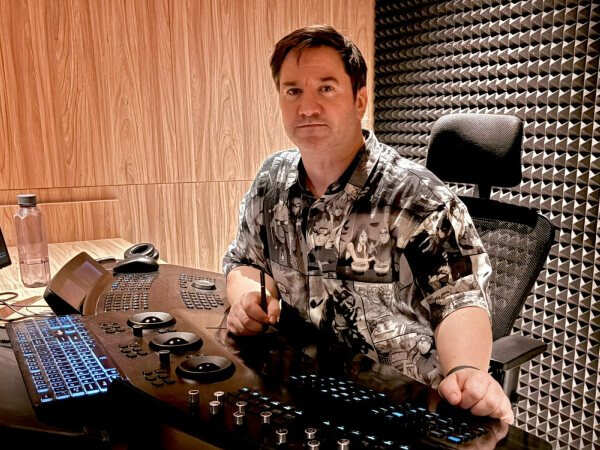
For our ongoing attempt to bring readers closer to the many departments that make cinema what it is, we spoke to Andreas Brueckl, the German-born senior colourist who has worked on acclaimed projects across India and internationally. With credits including Sacred Games, Delhi Crime, Paatal Lok, Jailer and Peddi, Andreas recently joined Annapurna Studios as its head colourist and is currently working on some of Indian cinema’s biggest upcoming films, including SS Rajamouli’s Varanasi.

In this conversation, Andreas takes us behind the scenes of Peddi, explaining how a colourist shapes a film’s visual world, what really happens in post-production, and why “fix it in post” isn’t as simple as it sounds.
Excerpts:
For those unfamiliar with the technicalities of filmmaking, what exactly does a colourist do?
We come in during the final stage of filmmaking, in post-production. Once the edit is locked, it’s mainly the sound team and us. One of our key tasks is to align the footage. A scene may have been shot over two months in completely different weather conditions, as was the case with Peddi, but I have to make it look as though it was filmed within five minutes. I’m also balancing every shot and helping create the film’s visual identity. I’m enhancing what the director of photography has captured. I’m working out things in the frame which are important, and I hide things to make them darker which are not important. That’s basically the main task of a colourist.
What does collaboration look like from your perspective?
Every project is different. Sometimes I’m involved as early as the script stage. I was Director of Visuals at a production company in Dubai, where I would join projects very early. Usually, a cinematographer approaches me once a project is locked, and we start exchanging ideas.
We discuss camera choices, visual references and the overall look of the film. Quite often, I help create mood boards so the director can visualise how the film will eventually look. On other projects, I join much later, after they’ve already been shooting for a year or two. As a colourist, I can step in at almost any stage.
Tell us about your journey on Peddi.

My main conversation was with the director of photography, Ratnavelu, or Randy. We wanted to work together on his previous film, but I was still based in Mumbai and couldn’t come to Annapurna Studios. Most major South Indian productions work there because of their long-standing relationship with the studio. Randy told me, “Let’s do the next film together.” Around the same time, I had a strong lineup with Varanasi and Jailer 2, so I decided to move to Hyderabad. We first worked on the Chikkiri song, where we experimented with making it look like it had been shot on film negative. We created a unique texture and atmosphere for it, and everyone later said it genuinely looked like film. That was in November, and it became our first real test to establish the visual direction for the movie. I officially started grading in January. Randy was still shooting at the time, but he would come in every few days, and we’d constantly exchange ideas and refine the look.
The final version audiences see must have gone through several iterations. What does that process look like?
The colour grading isn’t locked until the day we deliver the film. We’re constantly fine-tuning it. I honestly couldn’t tell you how many versions we created because we’re always trying to improve. If you compare version one to, say, version 40, they’re completely different. The core principles remain the same: making the film feel real, rural and believable while preserving natural skin tones. But we’re constantly refining every detail until the very last day.
We often hear the phrase, “We’ll fix it in post.” What’s the biggest misconception about that?
People in production absolutely hate that phrase. (laughs) We always say, “Fix it on set. I tell cinematographers that if they’re not happy with something on set, they shouldn’t assume post-production will solve it. My job is to enhance, not fix. Of course, some things are beyond anyone’s control, like the weather. But a good cinematographer captures the image as close to the final result as possible. That’s exactly what happened on Peddi. Apart from a few weather-related situations, most of the footage was already about 80 per cent complete on set. That allowed me to focus on improving it rather than correcting it.
When you first watched Peddi, what stood out to you before you even began grading it?
They were still shooting while I had already started grading. I didn’t get to watch the complete film until much later, and I didn’t even have the sound. So I had to rely entirely on the visuals. And they were stunning. The night cricket match, especially, stood out. You have these beautiful flares coming in from the left and right, and I really enjoyed working with them. Projects like this are simply fun because the imagery is already so strong.
What impressed you most about Ram Charan and Janhvi Kapoor while working on Peddi?
Ram Charan is simply outstanding. He’s an incredible performer. Janhvi Kapoor looked amazing. Honestly, I usually have to make small corrections on actors, but with Janhvi, there was nothing. Absolutely nothing. She looked stunning throughout.

You’ve worked on films across India and internationally. What continues to excite you about Indian cinema?
It’s getting bigger every year. I started working in India in 2017. Before that, I’d worked on films in Japan, Europe and Saudi Arabia. But the scale of Indian cinema, especially in the South, keeps growing. Take films like Peddi, Jailer 2 or Varanasi. If I tell my friends in Europe or the US about the scale and budgets of these productions, they’re blown away. They can’t imagine projects with budgets of around $140 million. At a time when the film industry is struggling in many parts of the world, especially in Europe and even the US, South Indian cinema is thriving.
SS Rajamouli truly put Indian cinema on the global map. It began with Baahubali and then RRR winning the Oscar. I had the opportunity to move to Los Angeles and work in Hollywood, but I consciously chose India because I believe the most exciting growth and the most interesting projects are here right now.
You recently joined Annapurna Studios. What has your experience been like, especially meeting Nagarjuna and his family?
I met Nagarjuna and his entire family in my very first week. They were all warm and welcoming. What impressed me most was that they had organised breakfast for the entire staff at Annapurna Studios, from the colourists and cleaning staff to the security guards. The whole family was personally serving breakfast to everyone. That was a wonderful first impression. It made my first week in Hyderabad very memorable.
AI is rapidly changing filmmaking. How do you see it affecting colour grading and the industry as a whole?
I recently worked on a film from Nepal where there was a scene of someone falling off a cliff. The director told me that they created that shot using AI. The only giveaway was that the sky looked slightly pixelated. He explained that recreating that shot practically would have been extremely expensive, and since they had a limited budget, AI made it possible.
AI will definitely become part of storytelling. The quality will continue improving, and I think we’ll eventually see films where perhaps 80 per cent is shot live, and 20 per cent is AI-generated. The live performances will remain real, but expensive VFX-heavy shots or sequences that take a lot of time and money could increasingly be replaced by AI. No one knows what the final balance will be. Today, I would estimate around 80-20, but in the future, it could even become 50-50.
One quote I recently heard really stayed with me: “AI will make the best people ten times faster.” I already use AI tools in my colour grading system, Baselight. I once had an assistant spend three weeks tracking actors’ eyes so we could subtly sharpen them. Today, AI can do that in about two hours. That frees up my assistant to work on more creative tasks. AI won’t replace talented professionals. Mediocrity, however, will have a much harder time surviving.
So could AI eventually replace colourists?
On lower-budget productions, it absolutely could. Commercials, for example, are already becoming increasingly AI-driven. Do those projects always need a colourist? I’m not sure.
For high-profile films, AI will remain a tool that helps professionals. But on smaller-scale productions, it may replace certain jobs.
What are some of the biggest misconceptions people have about your job?
There is a lot of misinformation online, especially in YouTube tutorials. Many people think they can simply apply a LUT, which is basically a predefined look, and the job is done. Others believe colour grading means making dramatic changes to the footage. Neither is true. The first thing we have to do is understand the footage. If you work against it, the image will immediately feel unnatural.
My job is to understand the cinematographer’s intention. Colour grading isn’t about pouring a bucket of colour over a scene. It’s about understanding the footage, refining it and maintaining continuity.
Is there one aspect of colour grading you’re especially particular about?
Skin tones. Skin doesn’t have just one shade. In many recent Bollywood films, I often see skin tones pushed into a flat yellow look, and I don’t think that’s natural. Modern cameras capture so many subtle variations in skin tone. We should preserve those nuances rather than wash them away. For me, skin has to look real. The way light and shadow fall across the face is what creates realism. I think audiences are becoming more aware of this too. As colourists, we need to pay much more attention to preserving natural-looking skin tones.
Which directors and cinematographers have you most enjoyed working with?
I’ve worked with almost everyone in Bollywood. What’s interesting is that, in recent years, many actors have also become directors. I’m good friends with Anupam Kher and Randeep Hooda. John Abraham is a lovely guy and, by the way, he speaks German. I also worked with Kunal Kemmu on Madgaon Express.
Earlier, my work was largely Mumbai-based. Now I’m very curious about the South Indian industry. I’ve already worked on films like Daaku Maharaaj and Jailer, and now I want to collaborate with more of the industry’s biggest stars. I will start working on Varanasi, and it will keep me busy for a long time. I also have Jai Hanuman 2 coming up, and I’m starting work on Jailer 2 very soon. I’m also working on Vijay Karthik’s next film, Mega 158. Hyderabad has been very good to me.
Also Read: Tollywood half-yearly report: How Telugu cinema fared with hits Peddi, Maa Inti Bangaram and more


 By
By