As a wide-eyed first-year mass communication student in 2017, walking into class each day meant a new lens on cinema and feminist studies. One lecture on Mira Nair’s Monsoon Wedding introduced me to a filmmaker whose portrait of the Indian diaspora leaves you with a distinctly bitter-sweet feeling. In the film, I recognised an aunt who panics through every family function, a father convinced his way of running the household is the only right way, and that one older cousin who looks out for you and holds up the mirror when the ‘perfect’ desi household’s cracks start to show. Nair’s shaadi does soak you in a hazy Delhi monsoon afternoon, but it also exposes the dysfunction underneath, like an annoying seelan (dampness) on the wall.
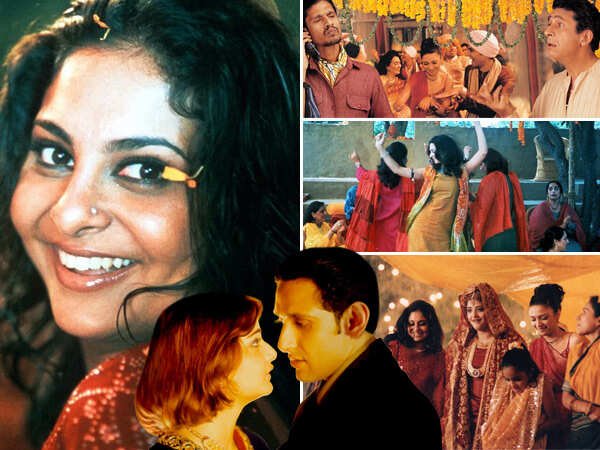
At 19, watching it with a classroom full of fellow students, we smirked mischievously as ‘Aaj Mausam Bada Beimaan Hai’ played behind PK Dubey (Vijay Raaz) and Alice (Tillotama Shome) trading glances, Dubey nearly swallowing a marigold in the moment. As the film opens up, it spills through every crack in the Verma family’s chaos: Naseeruddin Shah’s frustration with a son he thinks isn’t macho enough, Aditi’s (Vasundhara Das) inability to focus on her wedding while an affair with a colleague still lingers, and her cousin Ria (Shefali Shah) finally holding up the mirror to the family by calling out the revered patriarch Tej Puri (Rajat Kapoor) for abusing her as a child. The film keeps oscillating between sangeet rehearsals and the uncomfortable conversations underneath them. From Ria’s single status to Lalit’s reckoning with his brother-in-law Tej, everything simmers inside the chai ka pateela, threatens to boil over, and is pulled back just in time to be served hot as Aditi and Hemant’s wedding celebrations begin to ‘Aaja Nachle’.

Back then, the film was studied in class as a text on the cultural weight of Indian weddings and their grandeur. Monsoon Wedding never chases the loud, glossy Band Baaja Bride aesthetic; it’s marinated instead in the yellows and oranges of the auspicious genda phool. Its handheld camera, a quiet homage to the Dogme 95 movement, gives it the texture of a simple wedding shot on an old VHS tape. But what sits at the centre of this deceptively familiar docu-drama and this is where Nair’s documentary instincts show, is its ability to paint a vivid picture of a Delhi monsoon soaked in tradition versus modernity, class dynamics within an upper-class Hindu household, and agency in love.
Love takes centre stage in the film, told through parallel stories set against marriage as a ‘sacred’ and lifelong commitment. Nair has spoken about how Sabrina Dhawan’s writing of the younger couples’ romances was rooted in her understanding of a generation’s evolving dynamics in the early 2000s. The romantic tracks, Aditi and Hemant (the bride and groom), Dubey and Alice (the wedding planner and the house help), Rahul and Ayesha (the Indian-born Australian and Aditi’s cousin), and the charged, unresolved tension between Ria and Umang Chadha in the final scene, all together capture the rawness of desire and attraction navigating the societal norms of Indian culture. Twenty-five years on, in an era of left and right swipes, it’s worth wondering how these same dynamics would play out today. Would Aditi block her married ex after being left hanging? Would Rahul and Ayesha keep texting after the wedding, given what we’d now call their situationship? The nature of the conflicts and dilemmas may stay the same even 25 years on, but the language and resolution around them would almost certainly look different.

In parallel, the story confronts child sexual abuse and puts the entire Verma family in an impossible position. Seeing Tej Puri, her own abuser, circling a younger girl in the family again leaves Ria with no choice but to intervene. She’s slapped for it, and pulls away from the sangeet in the aftermath. What has stayed with me is that Lalit, the bride’s father and the closest thing Ria has had to one since her own father passed, stands by her. Even in 2026, such matters are rarely spoken about out loud within families. But screenwriter Sabrina Dhawan doesn’t take the easy way out. She has a chastened, indebted Lalit set the record straight, Tej Puri is no longer welcome at the wedding. Ria’s truth is acknowledged, and Lalit finally gives her the safe space she was denied for years. It never feels like a forced message; it plays as an organic apology from Lalit to Ria.
Watching this unfold with a room full of female batchmates, I remember the soft sniffs and heavy sighs around me. Some of us may have recognised something of Ria’s past in her; others felt it like a warm hug when she doesn’t fully recover but still dances her heart out with little Aaliya as it pours down on Aditi and Hemant’s baraat. The weight of that moment has stayed with me.

Rewatching the film at 28, some things that didn’t land at 19 make sense to me now. Nair’s choice to have the Verma family converse largely in English felt a little alien to me at first. Digging into her filmography later, her years split between New York and Kampala, a career-built studying in Delhi before Harvard pulled her away, it became clear why she’d bring a diasporic lens back to a Delhi wedding rather than an insider’s. Sabrina Dhawan’s own roots lie in Delhi, where she grew up before writing the screenplay as a film student in America. That distance gave her the sensibility of an outsider looking in, rather than someone too close to look at all.
I remember Monsoon Wedding through its visual language, its tenderness towards love, messy relationships, and family siyapa. I remember the pop culture moments from the sangeet’s Chunari Chunari face-off to Sukhwinder Singh’s Aaj Mera Jee Karda, that have stayed my favourite topics of debate with a fellow film buff. And I remember the hazier memory, at seven or nine, of picking out Monsoon Wedding’s cassette for its vivid yellow-and-orange cover and asking my maternal uncle about the film. He couldn’t explain much, so he just played the songs in the car instead. Funny how he wasn’t grooving and I was. Maybe because it was his own wedding chaos playing out at home, and I could feel it too.
Also read: 25 Years of Lagaan: Aamir Khan Made More Than One Impossible Dream Come True




 By
By




 By
By