
 Quick Take: The supernatural-devotional elements keep the boat afloat, but the film is weighed down by subpar writing.
Nagabandham: The Secret Treasure is yet another attempt from the Telugu film industry to blend mythological and supernatural themes with fantasy, devotion, and a treasure-hunt adventure. Written and directed by Abhishek Nama, the latest Tollywood release aims to deliver an Akhanda-style multi-genre spectacle.
At the centre is a holy temple and a sacred artefact called the Brahma Kamalam, which has long attracted invaders seeking its power. At its heart, the story pits the brutal Sultan Abdali against the temple’s protectors in a clash between self-destructive greed and unwavering faith. The film stays true to this central idea while moving through multiple time periods and locations. From the Himalayas of the late 1960s to an Archaeological Survey of India excavation site, from fictional places like Bhairavakona to the grand Srirangapuram Temple of the 18th century, and from the colourful Tulasi Vanam to a fervent village where a festival becomes the backdrop for intra-family conflict, the narrative spans an impressive geographical and temporal canvas.
The plot revolves around Rudra (Virat Karrna), an adopted son and devoted brother who is unaware of his divinity-laden destiny. Then there is the devilish antagonist (Rishabh Sawhney), whose quest for god-like powers sets him on a path of cataclysmic destruction. He resembles a merciless gangster whose appetite for bloodshed assumes mythical and quasi-historical proportions.
This is the kind of film where no ceremony is free of unexpected massacres or swaggering desperadoes suddenly storming the venue. The carnage is epic at times. Amid the chaos unleashed by demonic forces, themes such as unwavering devotion, fiery gods determined to uphold dharma, latent destiny, and, above all, the relevance of the powerful Naga Sadhus are never lost.
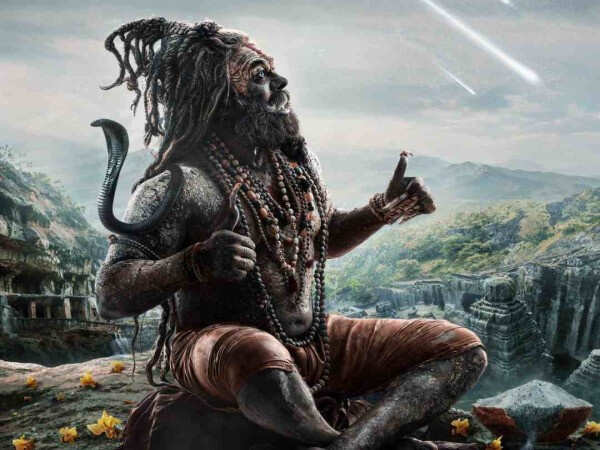
Virat Karrna anchors the film as Rudra, a Naga Sadhu tasked with leading the Nagabandham-coded battle. He brings physical intensity to the role, and it shows. When the stakes are this mythic, half-measures in performance feel false. Karrna commits wholeheartedly. His stillness in the temple scenes contrasts effectively with his ferocity in combat, and that contrast gives the character much of his weight.
Nabha Natesh plays Parvathi, a Vedic student. She holds her own in a film built for spectacle, giving Parvathi conviction rather than merely serving as decoration. Ishwarya Menon and Daksha Nagarkar don’t get much to do. Mahesh Manjrekar is excellent, despite the poor lip-sync in the scene where he passionately declares his faith. Murali Sharma delivers a sincere performance as a priest, while Jagapathi Babu, playing the “archaeological genius” Prabhakar, veers into melodrama.
Technically, the film is a mixed bag, with the visual effects looking underdeveloped in several places. Soundar Rajan’s cinematography captures both the intimacy of temple interiors and the scale of the larger-than-life battles. Junaid Kumar’s music and background score effectively support the film’s devotional and adventurous tone. The songs, however, feel forced.
The action sequences should have been far better. Several scenes openly defy gravity, with characters suspended mid-strike and weapons arcing through the air in exaggerated slow motion. They should have felt more dangerous and impactful. The choreography lacks rhythm and intensity, preventing the film’s biggest set pieces from delivering the force they promise.
Greater attention to the writing, screenplay, and character arcs could have added much-needed depth to the narrative. One of the film’s biggest shortcomings is its lack of emotional highs, largely because of the underwhelming screenplay.
To encapsulate, Nagabandham blends mythology, fantasy, and action on a grand canvas. While weak visual effects, uninspired action choreography, and underwhelming writing hold it back, its supernatural and devotional themes lend the film enough intrigue to remain watchable.
Also Read: SS Rajamouli Honoured at France’s Mur Des Cinéastes Alongside Martin Scorsese, Quentin Tarantino


 By
By