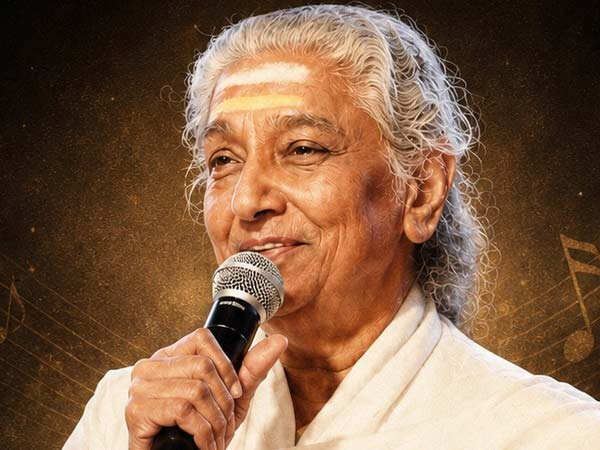
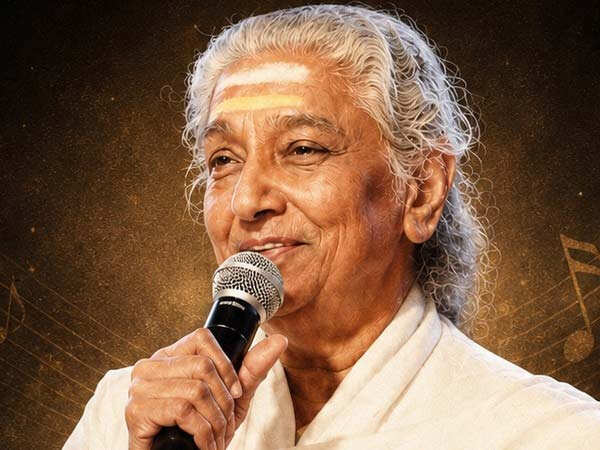


For more than six decades, S. Janaki possessed the rare gift of making every song feel deeply personal. Whether she was singing a tender lullaby, a heart-rending lament, a playful duet or a devotional hymn, her voice carried an emotional truth that transcended language. Revered across South India and admired throughout the country, Janaki was far more than a playback singer, she was the voice behind countless memories, shaping the soundtrack of generations.
Born on April 23, 1938 in Pallapatla, near Repalle in Andhra Pradesh, Janaki’s journey to musical immortality began with humble roots. Her father, Sistla Sreeramamurthy, was an Ayurvedic doctor and teacher, while her earliest lessons in music came not from a formal conservatory but from Nadaswaram vidwan Paidiswamy. She made her first public performance at the age of nine and, despite never undergoing formal classical training, displayed an instinctive musicality that would later become the hallmark of her singing.

At just 19, Janaki made her playback debut with the Tamil film Vidhiyin Vilayattu (1957). Remarkably, within the same year, she had already recorded songs in six different languages, offering an early glimpse of the astonishing versatility that would define her career. Over the next six decades, she would go on to record more than 48,000 songs across nearly twenty languages, becoming one of the most prolific playback singers in the history of Indian cinema.
Her artistry was recognised with numerous honours, including National Film Awards and state awards across South India. Among them were the Tamil Nadu State Film Award for Poda poda pokka from Uthiripookkal (1979) and the Andhra Pradesh State Nandi Award for Govullu Tellana from Saptapadi. Yet accolades never seemed to define her. Those who worked with Janaki invariably spoke of her humility, discipline and quiet professionalism rather than her towering achievements.
Few playback singers have enjoyed the kind of enduring relationships with fellow musicians that S. Janaki did. Across a career spanning six decades, she became the trusted voice of generations of composers and shared unforgettable musical chemistry with some of South India’s greatest singers.
Her most celebrated partnership was with S. P. Balasubrahmanyam. Together, they recorded thousands of songs across Tamil, Telugu, Kannada and Malayalam, creating a treasure trove of romantic duets, playful numbers and poignant melodies that continue to resonate with listeners. Equally cherished were her collaborations with K. J. Yesudas, whose rich, classical voice beautifully complemented Janaki’s expressive versatility. Earlier in her career, she also delivered memorable songs with P. B. Sreenivas, Malaysia Vasudevan, Mano and Dr. Rajkumar.

Among composers, Ilaiyaraaja occupies a special place. Their legendary partnership produced hundreds of timeless songs, with Janaki effortlessly bringing to life every shade of emotion, from innocence and longing to joy and heartbreak. She also adapted seamlessly to A. R. Rahman’s contemporary sound, proving her artistry was timeless. Whether working with M. S. Viswanathan, K. V. Mahadevan, Rajan–Nagendra or Hamsalekha, Janaki possessed the rare ability to become the voice each composer imagined, leaving behind a musical legacy that continues to enchant generations.
Away from the recording studio, Janaki remained one of Indian cinema’s most private legends. She married V. Ramprasad in 1959, whose unwavering encouragement proved invaluable throughout her career. He accompanied her to countless recording sessions and handled many professional responsibilities, allowing her to focus entirely on her music. His death from a cardiac arrest in 1997 was a deeply personal loss.
The couple had one son, Murali Krishna, whom Janaki carefully shielded from public attention. Like his mother, Murali had artistic inclinations and worked as a musician, while also appearing in the Telugu film Sruthilayalu. In one of the cruellest chapters of Janaki’s life, Murali passed away on January 22, 2026 in Mysuru following a prolonged illness. His daughter, Apsara Vydyula, confirmed that he died after suffering a cardiac arrest and requested privacy for the grieving family, while also assuring admirers that Janaki herself was in good health.
Despite unparalleled fame, Janaki never cultivated the aura of a celebrity. She was known to cook meals for colleagues during long recording sessions, maintained close friendships with fellow musicians and avoided the social circuit that often accompanied success. Deeply spiritual and naturally shy, she preferred the quiet comfort of the recording studio over award ceremonies and public appearances. In later years, she lived a peaceful life in Mysuru, making only occasional appearances for special musical events.
In 2013, Janaki made national headlines by politely declining the Padma Bhushan. She explained that while she was grateful for the recognition, she felt it had come too late in her career and expressed disappointment that many South Indian artistes were often honoured long after they had earned such recognition. Her decision sparked a wider conversation about the timing and regional balance of India’s civilian awards, reflecting the quiet dignity with which she always stood by her convictions.
Although she announced her retirement from films and stage performances in 2016, Janaki’s love for music never truly faded. She briefly returned to playback singing in 2018 for the Tamil film Pannaadi, a reminder that some voices can never be entirely silenced.
While S. Janaki’s name is inseparable from the golden history of South Indian cinema, her journey through Hindi films remains one of the most intriguing, and often overlooked, chapters of her extraordinary career. A singer who recorded over 20,000 songs across Tamil, Telugu, Malayalam, Kannada and several other languages, Janaki’s contribution to Hindi cinema was relatively modest, amounting to around 100 songs. Yet, what she left behind was a collection of unforgettable melodies that continue to be cherished by music lovers and musicians alike.

Her foray into Bollywood came in 1980s, when composer Bappi Lahiri reportedly heard a Hindi rendition she had recorded for a South Indian production. Struck by the richness of her voice, flawless diction and remarkable emotional expression, he introduced her to mainstream Hindi cinema. The collaboration proved fruitful, with Janaki becoming a familiar voice in several of his films. During this period, she recorded memorable duets with some of the finest singers of the era, including Kishore Kumar, Amit Kumar, S. P. Balasubrahmanyam, Mohammed Aziz, Manna Dey, K. J. Yesudas and Shabbir Kumar.

Though brief, her Hindi repertoire is studded with gems. The infectious Yaar bina chain kahan re (Saaheb, 1985) became one of the defining disco anthems of 1985 and remains a favourite decades later. The hauntingly romantic Dil mein ho tum (Satyamev Jayate, 1987) showcased the velvety texture of her voice and stands among Bappi Lahiri’s most enduring compositions. Equally impressive was Prabhu more avgun chit na dharo (Sur Sangam, 1985), a semi-classical masterpiece that highlighted her impeccable command over classical nuances and her ability to convey profound emotion with effortless grace. Another remarkable achievement was Pag paadam sangeet geet sargam (Naache Mayuri, 1986), a technically demanding dance composition that earned her the National Film Award and demonstrated her extraordinary classical training. On the lighter side, Sun Rubia tumse pyar ho gaya (Mard, 1985) revealed yet another facet of her artistry, proving she could handle lively commercial numbers with the same ease as deeply expressive compositions.

Janaki’s limited presence in Bollywood was never the result of a lack of opportunities. Instead, it was a conscious decision rooted in artistic conviction and personal comfort. At the height of her career during the 1980s, she was one of the busiest playback singers in South India, recording dozens of songs every month across multiple film industries. Her schedule often involved travelling between cities on the same day to honour recording commitments. Relocating to Mumbai would have meant stepping away from an ecosystem where she was already an indispensable musical force.
More importantly, Janaki believed that the South Indian film industries consistently offered her compositions that were musically richer and more challenging than many of the songs she was receiving in Hindi cinema. Rather than chasing a larger national profile, she chose to remain in Chennai, where she could continue working with composers who pushed her artistic boundaries. It was a decision that reflected her deep commitment to music over fame.
Although her Hindi filmography is comparatively small, it bears the unmistakable stamp of a singer whose artistry transcended language. Collaborating with celebrated composers such as Bappi Lahiri, Lakshmikant–Pyarelal and Anu Malik, S. Janaki enriched Hindi cinema with performances of rare beauty. Her voice may have echoed most often in the South, but the melodies she gifted to Bollywood remain timeless reminders of a truly exceptional artist.
S. Janaki leaves behind a musical legacy that is almost impossible to measure. Her songs continue to resonate across generations, languages and cultures, carrying with them joy, heartbreak, devotion and hope in equal measure. Yet beyond the astonishing numbers and countless accolades, she will be remembered for something even more enduring: a life lived with grace, humility and complete devotion to music. Her voice may have defined Indian cinema, but it was her quiet humanity that made her truly unforgettable.

Here are 10 of S. Janaki’s most iconic songs from each of the four major South Indian languages.
Tamil Hits
Singaara velane deva
Konjum Salangai (1962), composed by S M Subbaiah Naidu Duet by S Janaki with Karakurichi P Arunachalam (nadaswaram accompaniment)
Machana paartheengala
Annakili (1976), composed by Ilaiyaraaja Solo by S Janaki
Senthoora poove
16 Vayathinile (1977), composed by Ilaiyaraaja Solo by S Janaki
Kaatril endhan geetham
Johnny (1980), composed by Ilaiyaraaja Solo by S Janaki

Putham pudhu kaalai
Alaigal Oivathillai (1981), composed by Ilaiyaraaja Duet by S P Balasubrahmanyam and S Janaki
Meendum meendum vaa
Vikram (1986), composed by Ilaiyaraaja Duet by S P Balasubrahmanyam and S Janaki
Kanmani anbodu
Guna (1991), composed by Ilaiyaraaja Duet by Kamal Haasan and S Janaki
Inji iduppazhagi
Thevar Magan (1992), composed by Ilaiyaraaja Duet by Kamal Haasan and S Janaki
Aasai adhigam vechu
Marupadiyum (1993), composed by Ilaiyaraaja Solo by S Janaki
Malare Mounamma
Karnaa (1995), Composed by Vidyasagar Duet by S Janaki and SP Balasubrahmanyam
Telugu Hits

Ee Divilo Virisina
Kanne Vayasu (1973), composed by Satyam Solo by S Janaki (female version)
Sirimalle Puvva
Padaharella Vayasu (1978), composed by K Chakravarthy Solo by S Janaki
Padaharellaku Neelo Naalo
Maro Charitra (1978), composed by MS Viswanathan Solo by S Janaki
Andamaina Anubhavam
Andamaina Anubhavam (1979), composed by MS Viswanathan Duet by S Janaki and SP Balasubrahmanyam
Govullu Tellana
Sapthapadi (1981), composed by KV Mahadevan Duet by S Janaki and SP Balasubrahmanyam
Mounamelanoyi
Sagara Sangamam (1983), composed by Ilaiyaraaja Duet by S Janaki and SP Balasubrahmanyam
Tholisaari Mimmalni
Srivariki Premalekha (1984), composed by Ramesh Naidu Solo by S Janaki

Guvva Gorinkatho
Khaidi No 786 (1988), composed by Raj–Koti Duet by S Janaki and SP Balasubrahmanyam
Suvvi Suvvi
Swathi Muthyam (1986), composed by Ilaiyaraaja Duet by S Janaki and SP Balasubrahmanyam
Priyatama
Prema (1989) composed by Ilaiyaraaja Duet by S Janaki and SP Balasubrahmanyam

Kannada Hits
Yaava Janmada Maitri
Gowri (1963), composed by G. K. Venkatesh Solo by S Janaki
Naane Veene Neene Thanthi
Mavana Magalu (1965), composed by TG Lingappa Solo by S Janaki

Nannalli Neenagi
Nanna Karthavya (1965), composed by G. K. Venkatesh Duet by S Janaki and P. B. Sreenivas
Baanallu Neene
Bayalu Daari (1976), composed by Rajan–Nagendra Solo by S Janaki
Hoovondu Beku
Pavana Ganga (1977), composed by Rajan–Nagendra Solo by S Janaki
Sanje Thangaali Mai Sokalu
Kokila (1977), composed by Salil Chowdhury Solo by S Janaki
Jeeva Veene
Hombisilu (1978), composed by Rajan–Nagendra Solo by S Janaki

Omme Ninnannu
Gaali Maathu (1981), composed by Rajan–Nagendra Solo by S Janaki
Naguva Nayana
Pallavi Anu Pallavi (1983), composed by Ilaiyaraaja Duet by S Janaki and SP Balasubrahmanyam
Bombe Bombe
Annayya (1993), composed by Hamsalekha Duet by S Janaki and SP Balasubrahmanyam

Malayalam Hits
Unaroo Unaroo
Ammaye Kaanaan (1963), composed by by K. Raghavan Solo by S Janaki
Vaasantha Panchami Naalil
Bhargavi Nilayam (1964), composed by MS Baburaj Solo by S Janaki

Anjanakkannezhuthi
Thacholi Othenan (1964), composed by MS Baburaj Solo by S Janaki
Sooryakanthi
Kaattuthulasi (1965), composed by MS Baburaj Solo by S Janaki
Akale Akale Neelakaasham
Midumidukki (1968), composed by MS Baburaj Duet by KJ Yesudas and S Janaki
Aaraaro Aariraaro
Aaraadhana (1970), composed by K. J. Joy Duet by KJ Yesudas and S Janaki
Sandhye Kanneerithenthe
Madanolsavam (1978), composed by Salil Chowdhury Solo by S Janaki

Rithulayamunarunnu
Love in Singapore (1980), composed by Shankar–Ganesh Duet by S Janaki and P. Jayachandran
Thumbi Vaa
Olangal (1982), composed by Ilaiyaraaja Solo by S Janaki
Vaalittezhuthiya
Onnanu Nammal (1984), composed by Ilaiyaraaja Duet by KJ Yesudas and S Janaki
Also Read: Editor’s Take: S Janaki, The Voice of The Angel Has Been Stilled for Ever

 By
By