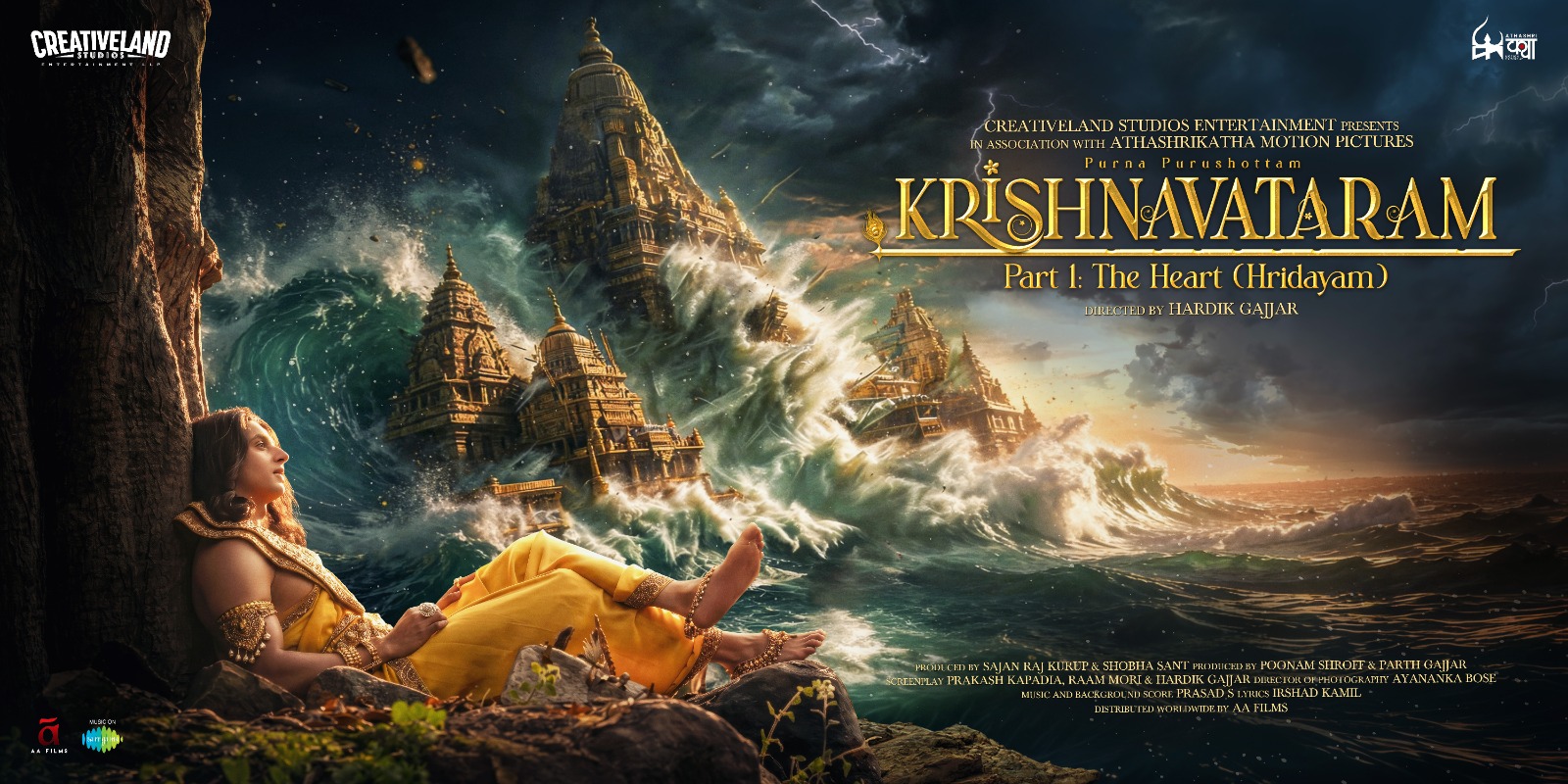

Devoid of stars and big studio, director Hardik Gajjar’s gorgeous film celebrates Krishna’s relationships and true love while simultaneously underlining the dichotomy of being an avatar of God.
Rating:  (4/ 5)

By Mayur Lookhar
One is gripped by anger each time you read or hear about heinous crimes against women and children. The frustration stems from our sense of helplessness in stopping such a menace. Often in these times, you question faith and ask, “Where is God when such barbaric acts are committed?” You rage for a while, but then remind yourself that despite being an avatar of God, Krishna couldn’t save Dwarka from destruction. The Lord himself surrendered to niyati (destiny). So how, as mere mortals, can we stop the inevitable, the moral decay in Kaliyuga?
“Being a human is tough, but it’s more challenging to live among humans as an avatar (of God),” says Krishna in a choked voice. Phew! God has never felt so human. You leave the theater with this lingering thought. But there are plenty of emotions that you carry in your heart. No wonder, the film is aptly titled Krishnavataram Part 1: Hridayam (2026).
Raam Mori is a young Gujarati writer known for telling feminist tales. He won the National Award for Best Gujarati Film for 21mu Tiffin (2021). He penned his first novel Satyabhama (2025), which serves as a key inspiration behind Krishnavataram Part 1: Hridayam. The other being Vyasa’s Brahma Vaivarta Purana. Mori’s novel pays reverence to Krishna, covering his legend through the eyes of Satyabhama, one of his eight queens. Mori placed faith in director Hardik Gajjar and principal writer Prakash Kapadia (story, screenplay, dialogues) to tell the ‘Satyabhama’ story on the big screen.
Story
Krishnavataram Part 1: Hridayam (2026) begins on a somber note as hunter Jara’s arrow accidentally strikes Krishna (Siddharth Gupta). In his final moments, the Lord recalls his promise to Radha to play the flute one last time. It reverberates miles away in Barsana, where Radha senses the tragedy and breaks down. Meanwhile, at Bhalka Tirtha, even the deer, peacocks, and birds mourn the divine loss.
We’re soon taken to present-day Jagannath Puri, where a youth dismisses the Hridayam as a legend. The priest (Jackie Shroff) isn’t disheartened, noting that many like this boy have confined Krishna to the Mahabharata alone. So, he decides to tell the life story of the revered deity. A few seconds later, the opening credits roll to pictures and idols depicting Krishna’s story right from childhood, instantly immersing you in the world of Krishnavataram Part 1: Hridayam.
We’re then taken back to Dwapara Yuga, where Bhama (Sanskruti Jayana) discreetly meets Krishna for the first time. That evening, Bhama is curious to know why this man is so loved in Gokul and Vrindavan. She urges her friend Subhadra to enlighten her about her revered brother. We urge viewers to discover the rest of the story themselves.
Screenplay & Direction
A man who had eight queens, known as the Ashtabharya. Krishna then freed 16,100 young women held captive by the demon Narakasura and married them to restore their social dignity. In today’s world, such tales would provoke talk of polygamy. Then there was Radha, his first and true love, though they never married. Well, if such criticism is leveled against revered religious figures in other faiths, the many wives of a Hindu deity surely raise eyebrows. It’s here that these stories need to be viewed in their proper context. As the Lord declared, “He lives in the hearts of all those who seek him”.
How remarkable that even after centuries, Krishna is identified with Radha, a woman he never married. As he said, the world would take Radha’s name before his. The Radha-Krishna story naturally gets special attention before we unravel how Rukmini, Satyabhama, and then Jambavati come into Krishna’s life. The next five wives, though, aren’t spoken of; we only get a glimpse of them during a family moment.

In Krishna’s eyes, their love embodied different qualities – Radha: sacrifice, Rukmini: wisdom, Satyabhama: devotion, and Jambavati: inner beauty. Mind you, it’s not all hunky-dory, with Satyabhama initially envying Rukmini. The film beautifully explores and celebrates Krishna’s relationships and true love. It pays respect to the women in his life, never objectifying anyone.
When it’s not about the heart, the film dives into Krishna’s great mind, his philosophy, belief in the karmic cycle, and strong faith in destiny. For all his divine status, this Krishna strikes as humane as any God can be. As stated before, to Krishna, being an avatar is more challenging. While Gokul, Vrindavan, Dwarka all refer to him as the Lord, Krishna only saw himself as an avatar.
The narrative appeals courtesy its fine writing, whereby Prakash Kapadia doesn’t resort to heavily Sanskritised Hindi. Jackie Shroff as narrator is a surprise choice, but Hardik Gajjar gets everything else bang on. Backed by a production house called Creativeland, Gajjar and his team have pulled in every ounce of their creativity into delivering a refreshing, artistic mythology film – one on par with a Sanjay Leela Bhansali period drama. Creativeland’s CEO Shobha Sant surely has learnt a thing or two from the master filmmaker during her stint at SLB Films. That experience has only helped Hardik Gajjar shape his vision for Krishnavataram.
Performances
History reminds us that successful mythological content in the Hindi space is often one devoid of star names, and placing faith in hidden gems has worked wonders. Hardik Gajjar and his casting director Kunal M Shah have certainly introduced some remarkable talents.
Siddharth Gupta as Krishna is a breath of fresh air. It’s often stated that the first requisite for playing divine characters is innocence and humility – qualities that appear natural to Gupta. He’s been around for some time, but Krishnavataram is his big career break, and the man from Uttarakhand grabs it with both hands. More than his look, it’s his calm, humble tone that strikes you. Even in verbal confrontations, Gupta barely lets emotions get the better of him.

Like a true charmer, he woos Radha with words, poetry, and music. His conversations with Rukmini are wise in nature. With Satyabhama, he is patience personified, happy to allay her fears without sounding offensive. For long, it was Nitish Bhardwaj in Mahabharat who epitomized Krishna, but Gupta emerges as an actor of real substance, offering a refreshing portrayal of Lord Krishna.
A rising name down South, Chennai girl Sushmitha Bhat makes her Bollywood debut. With the film also releasing in Tamil and Telugu, Bhat brings pan-India appeal, but what’s likable about her is her girl-next-door charm. Traditionally, many makers choose to present Radha as an ethereal beauty. While Subhadra sings glorious praise, you are touched by the simplicity of this Radha. She is not your demure girl, though, this Radha is energetic, matching Krishna word for word in their poetic conversations. And she isn’t afraid to question authority. Stunned to know she cannot marry Krishna; Radha questions her mother and even the Lord himself. These were times when past verbal commitments made by elders had to be honoured. Radha makes peace with it and, though sad, doesn’t sulk over parting with Krishna. Bhat lights up the screen with her simple but enchanting screen presence, backed by a compelling performance. Her chemistry with Gupta is the highlight of this film.

Then there’s our Bhama – later named Satyabhama for daring to speak truth. With a name like Sanskruti, she’s a natural custodian of Indian culture. Suggesting privilege (Uttar Pradesh Governor Anandiben Patel’s granddaughter) would insult her abundant talent. At first glance, she echoes Mahie Gill’s sensual timbre. But comparisons end there. Daughter of Yadava king Satrajit, Bhama enjoyed privilege and also proficient in martial arts. Perhaps Raam Mori’s masterstroke lies in empowering his protagonist. Jayana stuns from frame one. Screen magnetism. Tonal seduction. Near-flawless command. No mortal today claims divine sight yet through Satyabhama’s fierce devotion, she gives you a sense of being close to the deity. If Krishna owned the opening, Satyabhama seizes the closing. Her grief swiftly changes to joy of a spiritual reunion, while this reviewer is tearing up at the destruction on screen. All these centuries, we’ve chanted “Radhe Krishna”; Sanskruti Jayana would perhaps compel you to chant “Satyabhama Krishna” too. She was almost forgotten, but Jayana has immortalized the Satyabhama-Krishna story.
Nivaashini Krishnan as Rukmini defines ethereal beauty, but you admire her more for her wisdom.
Music / Technical Aspects
What is a Krishna film without quality music? Though we live in these heavily polarized times, Irshad Kamil penning songs for a Hindu mythology film rekindles faith in India’s inclusivity. He also makes his debut as a feature film composer. Quite a few of these tracks are fine tributes to the classic Radha-Krishna love. This is an album where the music is perhaps defined by the corresponding voice. Prasad S (Kunj Bihari), Shweta Mohan (Mukhha Dikha Jayo) offer pure devotion. Neeti Mohan and Sunidhi Chauhan get to have all the fun. It’s Shreyas Ghoshal and Sonu Nigam who bring the divine touch with Mann Ki Dasha and Anth Mein Aarambh tracks, respectively. The latter naturally has you tearing up. The music is largely Hindustani, but Kamil doesn’t shy away from using a strain of piano in Prem Ki Leela, while it’s the gentle guitar in Kunj Bihari. Ah, like its captivating drama, each track tells a story of its own.

The visual splendor is down to Gajjar’s vision, and turning that into reality is an abled team of Prakash Kapoor (art director), Swarika and Chokkas Bhaardwaj (production design). Honestly, mere mortals like us can’t even comprehend it. Be it Vrindavan, Mathura, Barsana, or Dwarka, each location has Krishna’s imprints over it. One can’t help but envy Ayananka Bose, who gets to capture this gorgeous world. Among the many breathtaking visuals is Radha-Krishna lying intertwined on a crystal-clear river stream, with their heads together and legs extended in opposite directions. Then there’s the Draupadi-Krishna meet before the swayamvar, perhaps some creative liberty here. That opening visual of Draupadi – phew! blissful. The most poignant moments are how Bose captures his teary leading protagonists. What’s likable here is that Gajjar does not overdo the VFX, opting instead to draw in audiences with pure drama and devotion. If we spotted correctly, the presence of dry red chilly might be the only thing out of place.
Final Word
Here’s a film that begins and closes on a somber note. Well, you accept it as niyati, but the most pertinent takeaway here is the Lord’s saying that a civilization that doesn’t respect women is not civilized at all and will meet its end. Draupadi, Radha, Rukmini, Satyabhama, and the 16,000 women had Krishna to protect their dignity, but in this Kaliyuga, many women and girls’ question, where are you, Lord? Divine intervention is perhaps wishful thinking, but the way to turn into a moral society is simply igniting Krishna’s values in our hridayam.
Video review to follow.


 By
By