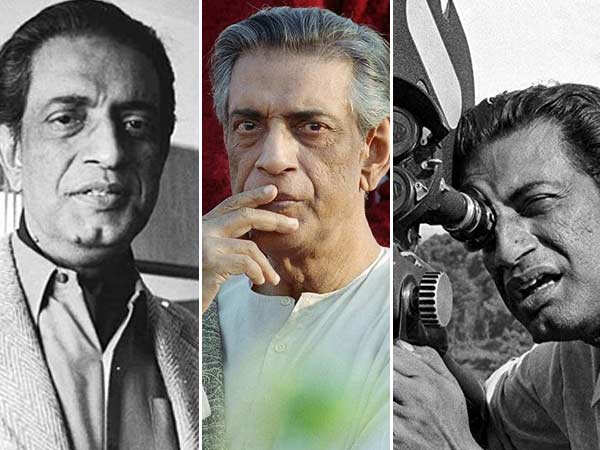


What’s left to say about Satyajit Ray. That he was a seminal influence on every filmmaker in the country whether they admit it or not. For me, it’s the moving images and the simple storytelling. While the world praised Pather Panchali, my heart went out to Apu and Aparna in Apur Sansar. To their little quaint but tragic love story culminating in little Kajol.
My heart goes out and hums Ami Chini Go Chini Tomare with the beautiful Madhabi Mukherjee and one of the best actors in the world, Soumitra Chatterjee in Charulata. To the shenanigans of those friends in the jungle in Aranyer Din Ratri who learn uncomfortable truths in pristine natural surroundings. And of course, my personal favourites Mahanagar, Devi and Nayak. Nayak for “Ektu bastobikotaar obhaab,” the bespectacled Sharmila (Tagore) in a fine performance sneering at Uttam Kumar and his world of movies.z
Happy birthday, Mr. Satyajit Ray. There’s so much you gave us. Your economy of expression, your shot taking, your dialogue, the actors you gave us. The world of Bengali movies and world cinema at large changed, thanks to your constant experimentation with form and story.
Mahanagar (1963)

When Aarti decides to take up a job to supplement her husband’s meagre bank job, in Mahanagar, hell breaks loose in the lower middle class household. The conservative bit impoverished father-in-law will not have his daughter traipsing off as a salesgirl. Anil Chatterjee tells his beautiful wife Madhabi Mukherjee that if she weren’t so beautiful he would have been less hesitant to send her for a job. Out in the big bad world, Aarti discovers new meaning to her humdrum existence much to the chagrin of her supportive but slightly jealous husband. Things reach a head and she’s about to quit, just then her husband loses his job.
Mahanagar ends on a slightly ambiguous note. Will the couple reconcile to the changing equation in the husband-wife relationship? Or, will they go back to their impoverished states again?
Satyajit Ray’s storytelling is top class and he deals with the complex story in such a simple manner. Madhabi immersed herself into the role of Aarti becoming the woman next door you meet every single day. She’s outstanding, as is Anil Chatterjee. Despite his somewhat unsympathetic role, he tugs at your heart strings. Also making a fabulous debut is young teen Jaya Bahaduri. Mahanagar is a simple tale, just so well told.
Charulata (1964)

Her binoculars trace the lively happenings on the street. Through the iron bars, the beautiful Charu watches the goings on. The camera gently following her making her look like a bird in a gilded cage. Set in the times of the raj, Charu is the intelligent, gorgeous but neglected wife of a newspaper editor ( I’m certain Hrishikesh Mukherjee’s Anupama and Basu Bhattacharya’s Anubhav were based on Charulata).
The newspaper editor is an arm chair intellectual and has no time for his wife. Enter his handsome brother Amal (Soumitra Chatterjee). Sparks fly between the brother and sister-in-law. Evocative are the scenes in the garden where Charu is on a swing, or the magical Kishore Kumar number Ami Chini Go Chini Tomare where Subrata Mitra’s camera sets the stage for a romance to develop. Romance blossoms, Charu’s article gets published in a magazine and her literary interests bloom.
But Amal is too weak a man to take a stance and moves on. Her husband realises late what has transpired and attempts at a reconciliation. The tableau like open ending leaves you guessing. Charulata’s pace makes you impatient but what you also get to see is a mind of a genius that Satyajit Ray is. He paints such intimate portraits despite the obvious magnificence of the surroundings. Nothing escapes his sharp eye and the detailing in Charulata is evocative.
Charu’s expression, which changes in the swing, as it to point out her epiphany, is one such great moment. She realises she’s in love with her brother-in-law and there’s no looking back. It’s a masterpiece moment. Madhabi’s performance in Charulata, which was based on Rabindranath Tagore’s Nastanirh, set the benchmark for the portrayal of many Tagore heroines in the future.
Nayak (1966)

So, now young Aparna from Apur Sansar is an all grown up Aditi in Satyajit Ray’s Nayak. She is a newspaper journalist who has absolute disdain for movies and movie stars. A chance encounter with a superstar Arindam Mukherjee played splendidly by Uttam Kumar triggers off a change of heart. He’s travelling to Delhi to receive an award. Ray examines the mind of a fan and detractor, probes into the shallow nature of commercial cinema and also at the heart of it is tenuous story about two individuals thrown together in a train journey.
At first, Aditi smells the opportunity of a great story interviewing the superstar on the train. He rebuffs her saying they deal with “shadows,” no need to get deep into his life. But as the journey unravels, he feels the need to exorcise some of his demons and seek “therapy.” After all, he has given up his first love theatre for the lure of crass movies.
His success is typified by wine, women and song. He has an overwhelming dream about drowning in his own money when he decides to unburden his heart to the “journo.” Does Aditi change her stance about the movie business? At the end of the journey, as Arindam puts on his dark glasses and gets lost in the waiting crowds, she realises no one is good or bad as the movies paint but just human.
Could arindam and Aditi have fallen in love? Is it Ray’s sharp critique of mainstream cinema. Nayak gives you no answers but leaves you enough food for thought. Watch it for a profoundly moving experience. The first shot, which shows a blank slate and dissolves into Uttam Kumar combing his hair is a master stroke, just like the film is. Also, watch the scene where Sharmila tells Uttam movies are “bastobikotaar obhaab” or far removed from reality. This is a gem.
Aranyer Din Ratri (1970)

A quartet of city slickers go into the jungles of Bihar for a retreat and come back with lessons of a lifetime.
At one level, Aranyer Din Ratri does seem as an allegory examining man versus nature. On a more personal level, it examines human foibles and triumphs. It’s funny, joyous and disturbing. It’s almost Satyajit Ray was instructing the actors through his camera to explain the human predicament and how life ought to be lived. At one level, it could also be a critique of the anglicised bourgeois of Kolkata who are more English than the English themselves.
Enter Aparna and Jaya who prick the bubbles off the complacent foursome. Sharmila Tagore’s Aparna is composed and perhaps even more sensitive and more intelligent than the suave Asim (Soumitra Chatterjee) who is slowly but surely falling in love with her. Chatterjee is outstanding as his veneer of sophistication crumbles slowly.
The impetuous Hari gets involved with the tribal girl Dhuli (Simi Garewal) while the other with his middle class pretentiousness is too scared to commit to the widow Jaya. A word game in the jungle is a psychological probe into each character and asim gets fiercely competitive and Aparna, in show of grace, lets him win the race. Time and again, the women come off as stronger characters, showing the men their failings and warts. Aranyer Din Ratri ends with hope and loads of lessons learnt. It’s a difficult but terrific film to watch.
Seemabaddha (1971)

The big bad world of corporate Kolkata is the setting for Satyajit Ray’s Seemabaddha. Barun Chanda debuts as an upwardly mobile executive who is ruthlessly ambitious and will pull out all the stops. He is aided in his hustling by his luxury loving wife. Into this idyll comes his sister-in-law Tutul (Sharmila Tagore), who is in love with a firebrand revolutionary whose life is never shown or explained. But he’s clearly the opposite of her bourgeois brother-in-law. While Sharmila is gradually being impressed by the show of grandeur, she can’t help being revulsed by her brother-in-law’s overarching ambition.
In a bid to become the director in his company, Shyamal goes a bit too far. He compromises a colleague and a lowly worker and is almost cavalier in his hustling. The last scene shows Tutul removing the watch he has gifted her. The voice of conscience has returned.
Barun Chanda as Shyamal is parts likeable parts loathsome – a good measure of his acting prowess. Sharmila, as always, is effective. Ray’s critique of post colonial india and the Kolkata bhadralok after the days of the raj, is genteel and yet incisive. It’s an intimate film and yet all encompassing in its details especially of human frailties. Another film I love revisiting.
Also Read: Exclusive: When Soumitra Chatterjee Feared He Wasn’t Good-looking Enough, Faced Inferiority Complex


 By
By