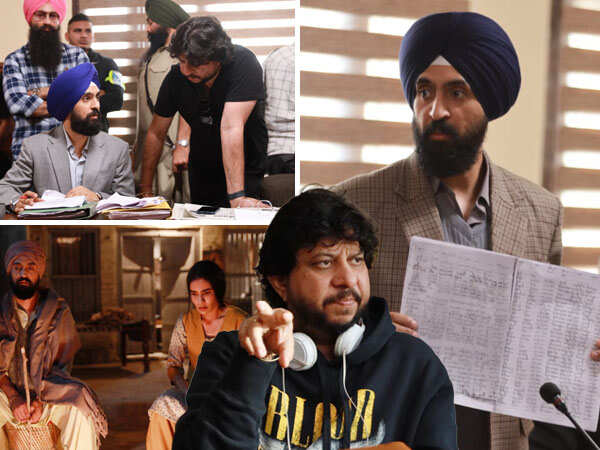


When I first reached out to Honey Trehan on the Friday evening that Satluj quietly premiered on ZEE5, he had an unsettling prediction, keeping his past experiences in mind. He felt the film wouldn’t remain on the platform for long. Exactly two days later, it was banned. Its removal marked another chapter in a journey that had already stretched over three years.
Earlier titled Punjab 95, the film is based on human rights activist Jaswant Singh Khalra (played by Diljit Dosanjh), who exposed thousands of alleged illegal cremations carried out by the Punjab Police during the militancy years. Khalra’s work eventually led to his own abduction and murder in 1995. His killing resulted in convictions that were upheld by the Supreme Court, making the case one of independent India’s most significant human rights prosecutions.
Yet bringing that story to the screen proved to be a battle in its own right.

Why Punjab 95 became Satluj
After years of back and forth with the Central Board of Film Certification (CBFC), Punjab 95 arrived on ZEE5 as Satluj. There were no promotions. Looking back, Trehan says the title change itself was an attempt to ensure the film reached audiences without inviting fresh hurdles.
“The earlier title was Ghallughara (genocide), and then it became Punjab 95. ZEE wanted to release the film with a different title. The idea was that if news got out, then the pressure would build up again. So they asked if we could have another title. Satluj was another title I already had. It is a river that binds Punjab together. It flows through the state, gives water to Rajasthan and neighbouring states. But it also carries another history. Many people who were abducted or killed in extrajudicial killings were thrown into the Satluj. Even Jaswant Singh Khalra was cremated there. I felt the title carried more poetic justice for the film.”
Trehan, however, agreed to the change with one condition. This had been his condition even when the censor board asked him to make over 120 cuts to his film. He wanted the film to be released without any changes. And ZEE 5 agreed to that.

“I told RSVP (production house) that there should be no cuts. They said, ‘Don’t worry. Even ZEE loves your original film.’ So, I agreed. It became Satluj. And after two and a half days it was removed again,” he says.
When I remind him that he had predicted this earlier, he says it was a hunch. “It wasn’t that we knew it would be removed. It was just a hunch. Because people tried to stop the film so many times that we had the hunch it would be removed again by the establishment.”
The Film’s Removal and the Unexpected Response
The explanation he was given for the film’s removal still amuses him. “If I tell you the reason, you’ll laugh”, he says. According to the filmmaker, the film was removed because it could allegedly create a law-and-order situation in Punjab. Nearly three weeks later, he says, everything that has transpired points in the opposite direction.
“On the contrary, this film united Punjab. It didn’t matter which caste, religion or background people came from. Thousands of people are sitting together and watching the film.”

Ironically, taking the film off the OTT platform seems to have only expanded its reach. Satluj found another life through community screenings, gurdwaras and pirated links.
“People are watching the film in gurdwaras and community centres. Not only in Punjab, but people are holding screenings in Jammu, Haryana, Pune and Bombay. Most of these are BJP states. The film is being screened at Gurdwaras, following which people are having langar. That was unexpected. Having said that, I do not endorse piracy. For any filmmaker, it is painful when their films are pirated”, he remarks.
He believes that response alone weakens the argument that the film could disturb public order. Then why such fear? He explains, “Probably they fear Punjab coming together. While this film is uniting Punjab, politicians are making speeches asking, ‘Punjab ke Hindu, kab jagoge tum?’ Somewhere you’re trying to break people’s faith in unity and harmony.” He continues, “You cannot insult the intelligence of our people by saying the film will disrupt national security. You can’t insult our Army, Navy or Air Force. This is such a big and strong nation. We’ve gone through many things and always come out as winners. How pitiful it is to say one small film will break the harmony of this country and become a national security threat. I don’t buy that argument.”
Inside the Censorship Battle
Long before Satluj briefly appeared on ZEE5, the film was embroiled in a prolonged battle with the Central Board of Film Certification. Over the course of nearly three years, the film remained in limbo as objections mounted over its subject matter, characters and references to documented historical events.
During one of the hearings, a member of the Revising Committee asked Trehan, “Who speaks the truth so loudly in
today’s time?” For the filmmaker, that question revealed the heart of the resistance that the film had encountered.
Asked what exactly people were afraid of, Trehan doesn’t hesitate as he says, “The fear of the truth. Because it’s a dark truth. It’s about things which were done by the establishment. Doesn’t matter which regime. But it was a well-organised crime. A common man stood against the system, against the establishment, against the State. Obviously, they will not take it easily. Probably they feared that because you’re pointing a finger at the police. Any crime happens, whether it’s small or big, your go-to person is the cops. So they think it’s breaking the faith in the police system.”
 He is equally clear about what he believes the film is not saying. “But that’s not what my film says. I’m not addressing the entire police system. So many times it’s been said in the film, ‘few policemen’. Few policemen who misused the power given to them. If you give obnoxious power to people, a few people will misuse that power. That’s a human error. The film talks about that.”
For Trehan, the larger point is that the film isn’t built on speculation. “The entire film is based on legal testimonies and records. Not by one court, but by four courts. The CBI Special Court, the Sessions Court, the Punjab and Haryana High Court and finally the Supreme Court of India. If somebody wants to be blind and overlook these facts, then I’m not here to answer them. As a filmmaker, my work should speak for what I believe,” he states.
Throughout our conversation, Trehan repeatedly returns to one idea. Satluj isn’t demanding that audiences agree with it. It is demanding the right to exist.
The Propaganda Debate
That naturally leads to another debate that has followed the film since its release and removal. If one politically charged film reaches audiences with little resistance while another spends years trapped in certification battles, who decides what qualifies as propaganda?
Trehan doesn’t attempt to define the term. Instead, he questions the idea that films should be stopped from reaching audiences in the first place. “There should not be any ban or any censor. It shows the nation in a poor light. We say it’s a democratic country. Then who has given CBFC the power to become God? Their job is to certify films. Who are these people to tell the audience what they should watch? Let the people of this country decide that. Why does the government need to tell us what to watch, what to do, what to write and what not to write? These things will never make the nation healthy.”
He says he is even willing to accept the argument made by some critics. “If a few people are saying it’s a propaganda film, I buy it. But other propaganda films have also seen the light of day. Allow this one as well. Let me release it. Why will only The Kashmir Files and The Kerala Story see the light of day? Because the Muslims are the villains in those films?”
For him, the issue isn’t whether cinema should be political. It is whether different political narratives are being treated differently. He is particularly critical of the role he believes the censor board now plays. “CBFC needs to respect its individuality. But now CBFC is being hijacked by the Ministry of Information and Broadcasting. That is becoming a backdoor entry for the government to enter into the film industry to control the narrative. Anything which is in their favour and supports their politics is being screened, even in Parliament. Those films are tax-free. But they ban anything that has nothing to do with their politics. That’s not a sign of a healthy country or a healthy establishment. It’s a cowardly act.”
Can Art Exist Outside Politics?
The conversation, however, circles back to another question that has long divided artists themselves. Can art exist outside politics?
When asked about the Cockroach Janata Party’s protest at Jantar Mantar, Diljit Dosanjh had replied that he was an artist and preferred not to comment on politics. The remark sparked a wider discussion about whether artists can or should separate themselves from political conversations.
Trehan, however, believes the context behind Dosanjh’s response is important. “I don’t think he knew about the protests when he said that. But if somebody tells him about the situation, he will come in support. He was too busy with his shows and world tour. He had no accounts about what is going on in India. Diljit is a guy with a very clear conscience. He was not only there at the farmer protest but also paid one crore rupees to the families of people who died in the protest.”
But for Trehan, the larger question isn’t about one statement or one protest. It is about the relationship between art and politics itself. He explains, “No art is different from politics. Art is the reflection of politics. Everything is political in today’s time. Politics is not a bad thing. But how it’s being used depends on people. What is your politics? That is very important. Healthy politics builds a healthy nation.”
Why He Wanted to Tell Jaswant Singh Khalra’s Story
For all the political conversations surrounding Satluj, Trehan says the film began somewhere far more personal. He had grown up in Tarn Taran, Punjab, where stories from the militancy years were part of everyday conversations.
“I was brought up in Tarn Taran. Since my childhood, I listened to these stories. During COVID, I was in quarantine, and I started reading about certain things. Mr Khalra’s story kept coming back to me again and again. I thought, ‘Let’s read more about this.’ Then finally I decided this would be my next film. I told Diljit about it, and he was excited too.” What followed, Trehan says, only deepened his admiration for the actor.
Working with Diljit Dosanjh
Much has been written about Dosanjh waiving his fee for the film, but Trehan says that narrative often misses the nuance of what actually happened.
“Diljit told me that he cannot ask for money to play Jaswant Singh Khalra. He was such a great martyr and lived his life for other people. ‘If I ask for money to play him, I’ll be disgracing myself,’ Diljit told me. I told him the contracts aren’t valid unless there’s an amount written. He said, ‘You and the producers decide whatever you think is right. I’ll accept it. But I cannot ask for money to play this role.'”
Another incident during the shoot, he says, revealed the kind of person Dosanjh is away from the spotlight. “He was called on February 3, but gave his first take on February 16. He sat idle in the hotel for thirteen days without any complaint, because I had to finish Suvinder Vicky’s schedule first.
When I would walk into Diljit’s room, before I could say anything, he would hug me. He used to tell me, ‘Paaji, you are making an important film. Don’t think for a second that I’m sitting idle or waiting. Whether you need me for thirty-five days or more, I’m with you. Whenever you need me, I’ll come.'”
One question, however, continues to linger. The events depicted in Satluj took place under a different government. If that is the case, why does he believe the film continues to face resistance today? He explains, “Politics… probably. I think they don’t want the common man to enter that territory and start talking about these issues.”
What Lies Ahead
Now that the film’s theatrical and OTT release have been blocked, what happens next?
Trehan admits he doesn’t have an answer. “I have no idea. I just pray everything falls into place. The government should make it legal. I think the government has taken things upon its ego. I want to tell them that nothing is going wrong. Let this film come out. Let people sit peacefully at home and watch it.”
For now, though, his attention has shifted back to writing. “I’m working on a biopic of Shiv Kumar Batalvi. I’m also contemplating one or two more subjects. Everything is in the writing stage right now,” he concludes.
Also Read: Exclusive: Arjun Rampal Opens Up About Meeting Jaswant Singh Khalra’s Family While Shooting Satluj


 By
By



 By
By