Shah Rukh Khan has given us enough romance content to make generations after generations delusional. Every time he looks into one of his heroines’ eyes, you get butterflies in your stomach. When he sings Pretty Woman, you imagine he is singing it for you. When he delivers a monologue straight from his heart to Naina at a railway station with a hundred people around them, you act like that confession was meant for you.
But I blame Rahul Raichand from Kabhi Khushi Kabhie Gham the most. What do you mean, “Na Lucknow da kurta, na Pathani salwar, mard woh hai jo dil de, varna hai bekar”? Where are these men? Okay, that might be a conversation for another time.
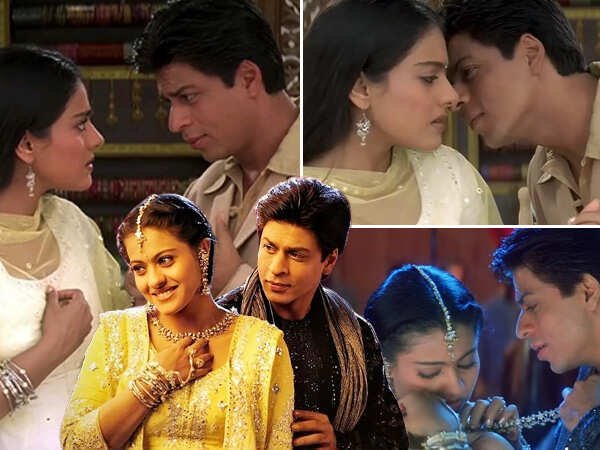
Karan Johar’s Kabhi Khushi Kabhie Gham was released on December 15, 2001, and went on to become one of the defining Hindi films of its time. The story follows the wealthy Raichand family and the rift between Yashvardhan Raichand (Amitabh Bachchan) and his adopted son Rahul (Shah Rukh Khan) after Rahul falls in love with Anjali Sharma (Kajol), a woman from Chandni Chowk whom his father does not approve of.
Twenty-five years later, K3G refuses to be forgotten. And neither does Rahul Raichand. The film not only gave us iconic pop culture moments, unforgettable dialogues, songs and a striking wardrobe, but also created a world where everything was larger than life.
It was a huge, excessive family film, and romance was one of the ways it made that world emotionally irresistible. Within that world, Rahul became a particularly enduring romantic fantasy.
The fantasy was obvious enough. He was the wealthy Raichand heir, and she was Anjali Sharma from Chandni Chowk. They came from completely different worlds, and yet Rahul chose her. Even when his father, Yashvardhan Raichand, made it clear that she was not the woman he had imagined as his daughter-in-law.
And this was not just a man going against his father’s wishes. Rahul was the elder son who had grown up deeply attached to his family, especially his mother Nandini (Jaya Bachchan). As the adopted son of Yashvardhan Raichand, his place in that family already carried its own emotional weight. So when he chose Anjali, he wasn’t simply choosing the woman he loved. He was making a choice that would cost him the family he loved too. He later explains to Anjali, “Tum nahi samjhogi. Kisi paraye ko apna kar aur phir paraya kar dena…is baat ka dard tum nahi samjhogi.”
That is where the real delusion began. It was the fantasy of being chosen against all odds. Of having someone look at you, decide that you are the person he wants, and then stand by that choice.
And Anjali was not presented as some perfectly polished heroine of the early 2000s. She was loud. Fearless. Unapologetic. She spoke her mind, broke ‘gamlas’ everywhere she went and was, as Rahul described her to his mother, “thodi si pagal hai…actually, bilkul pagal hai.”
Rahul loved that about her. There was no makeover required like in Main Hoon Na or Kuch Kuch Hota Hai. No sudden transformation into a softer, quieter version of herself to make her more desirable. She was enough as she was. The film makes you believe that the right person will look at all the things you have been told are too much and find them lovable instead.
Who better to sell that fantasy than the King of Romance himself?
Then there was the fact that Rahul was not the stereotypical macho hero. He was emotional and expressive. He cried. He apologised. He said what he felt. He loved his mother deeply. He loved his wife openly. Most importantly, when it came to Anjali, he did not hide behind the age-old excuse of “Ghar wale nahi manenge.”
That made Rahul an aspirational kind of man in a way that had little to do with his wealth.
Take the mela scene. As he gets closer to her and puts bangles on her wrists, he tells her, “Dosti ke alawa bhi kuch rishte hote hain. Kuch rishte jo hum samajhte nahin, kuch rishte jo hum samajhna nahin chahte…Aise rishte jo dil ke rishte hote hain, pyaar ke rishte hote hain, mohabbat ke rishte hote hain.” That is the kind of scene that made women look at the screen and think, yes, I want this.
The film also made sure there was never any shortage of romance to consume. “Yeh Ladka Hai Allah” gave us the flirtation, “Suraj Hua Maddham” gave us the sweeping fantasy and “Bole Chudiyan” turned romance into a full family event. Add the clothes, the foreign locations, the grand sets, the comedy, the tears and the sheer excess of it all, and K3G created a universe where love was never supposed to be ordinary.
Romance was part of the larger fantasy of the film, where even falling in love came with music, spectacle, family and celebration.
Maybe that’s why Rahul Raichand survived.
Today, we have reels cutting together his best romantic scenes. His dialogues appear on Instagram. His looks are recreated, his scenes are clipped and shared, and younger audiences who were not even alive when K3G was released are still discovering Rahul through fifteen-second videos.
The fantasy didn’t change twenty-five years later. Rahul Raichand may not be the perfect human being. Shah Rukh Khan has given performances far more complex and nuanced than K3G. The film itself has enough logical loopholes.
But who cares?
If you look at a character and feel love, feel like falling in love, and believe in love a little more, does anything else really matter?
That was the power of SRK’s character. He became the man generations of women imagined they could fall in love with. Not just because he was rich, handsome and charming, but because he made the fantasy of being chosen feel possible. And 25 years later, we are still looking for a little piece of Rahul Raichand.



 By
By


 By
By