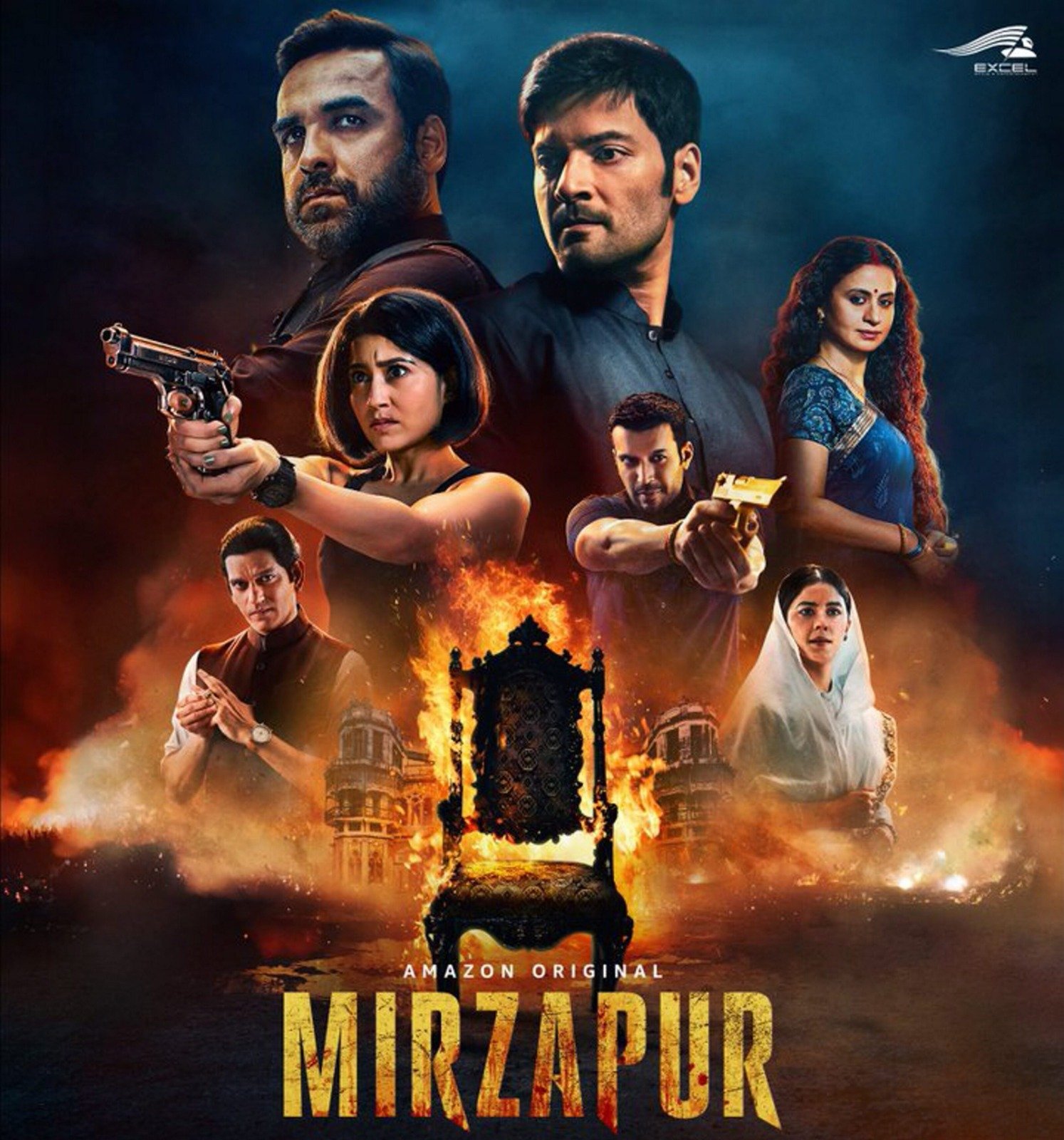

Excel Entertainment naturally offers a filtered version of their popular crime action thriller series for the big screen. Initially tardy, Mirzapur: The Movie rides on the back of stellar acts by Ravi Kishan and Ali Fazal.
Rating: 
 (2.5 / 5)

By Mayur Lookhar
An honest admission. This reviewer hasn’t watched a single episode of the popular crime action thriller series Mirzapur. Having experienced Sacred Games, yours truly simply had no further appetite to watch similar content. The word around Mirzapur then (2018) was that it was bold, abusive, and brutal. This writer, however, was privy to the critical acclaim that the first few seasons received. Eight years later, it’s difficult to catch up with the series, but this also meant that many, like this reviewer, would be introduced to the world of Mirzapur on the big screen.
A theatrical release naturally brings your content under the ambit of the Central Board of Film Certification, and Excel Entertainment and Amazon MGM have accordingly offered a filtered version of their popular web series for the big screen.
The one character who truly intrigued us is that of Gajgamini aka Golu Gupta (Shweta Tripathi). She is not anywhere close to being the central character, but her words strike a chord. In the library, she tells Vinay ‘Bablu’ Pandit, “Buddhi se violence ko roka jaa sakta hai” (Intelligence can curb violence). Wow, such a character feels like an aberration in the world of Mirzapur. However frivolous as it may sound, it’s one that’s seconded by your reviewer too. Honestly, the spate of violent content over the years has been tough to digest. Maybe, through a Golu, director Gurmmeet Singh and creator Puneet Krishna want to appeal to the audience that believes in dialogue over violence. Contrast this to Vasudha Pandit (Sheeba Chaddha), a woman who takes pride in being Guddu’s pandit mother. Violent, non-violent, Mirzapur: The Movie perhaps wants to reach out to audiences of all kinds.
Story
Such crime thrillers are often about holding onto or grabbing power. No one in Mirzapur would openly dare to challenge Akhandanand Tripathi aka Kaleen Bhaiya (Pankaj Tripathi), and so it’s Babban Yadav (Ravi Kishan), a rank outsider from Jaisalmer, who plots to topple Kaleen Bhaiya and rule over Mirzapur. What’s the killer plan? Well, best that the audience discover for themselves.
Screenplay & Direction
At 197 minutes, a desi crime action thriller can be a serious test of patience. The first half of the film feels dull, stretchy, soaked in drama and Bahubali swag, and mixed with boring romance. Honestly, it was merely Ravi Kishan, a new entrant to Mirzapur, who kept us from dozing off. Post the break, Gurmmeet Singh and Puneet Krishna pour their creative juices to dole out a thrilling drama, culminating in a wild desert conflict, one that engages you even after the end credits begin to roll. The last season and this film promised bhaukaal (havoc/carnage). By the end of Mirzapur: The Movie (2026), the lingering thought, rather equation here, is that of Bahubal + Balam = Bhaukaal.
Acting

This genre is seldom about story, but more about characters, and Excel Entertainment is blessed with a gifted cast. No stars, but serious talent, all of whom have helped make their respective characters household names. Yet, it’s Ravi Kishan, the new entrant, who leaves a lasting impression. Kishan’s Babban Yadav aka Babbua is an intriguing character. Ambitious, scheming, but likable as the Bahubali in love. And he’s truly loyal to his Mumtaz Bibi (Sonal Chauhan). Unlike a Kaleen Bhaiya, who really has no emotional connection with his musclemen, Babban Yadav cares for his trusted aides. Fathom this: in one scene, his most trusted sidekick is caught in a desperate situation, and Babban urges his rival Bhairav Singh Karnavat (Sushant Singh) not to torture his man. When Bhairav passes the phone to Babban, the latter gently asks his man, “How many bullets do you have left in your gun?” The sidekick says one, and Babban orders him to fire at Karnavat. However, left with blurry vision after taking a few bullets, the man says it is not possible. Then, with sadness in his tone, Babban tells his guy, “Be rest assured that I will take care of your family.” The next moment, the loyal sidekick shoots himself. Equally loyal is Birju Lohar (Mohitt Maalik), another Bahubali driven by love. Phew, this gang is made up of loyal men who value word and relationships. The most striking image of Babban is when he offers a helpless woman a shot at escaping from his evil kin, in return for nothing but respect and freedom. How can this man be the main antagonist in Mirzapur: The Movie?
Truth be told, none here are fit to be called protagonists. Of all the dark characters, it’s Babban Yadav who truly earns our respect. Credit goes to Kishan, who delivers a virtuoso performance, forever making Babban Yadav unforgettable in the power tussle of Mirzapur.
The other truly powerful performer here is Ali Fazal, a gentleman who has merrily embraced the madness of Guddu Pandit. His pride is more dangerous than his gun, and coupled with his bulky frame, Guddu Pandit literally strikes as a raging bull. His epic hand-to-hand combat with Babban Yadav, a fierce Bahubali himself, is a sight to behold. There’s little to like about this whacko, but it’s the brilliance of Ali Fazal that draws people to a Guddu Pandit.

Jitendra Kumar, who succeeded Vikrant Massey as Bablu Pandit for the film, truly feels like the odd one out in this big, bad world of Mirzapur. The brothers are like chalk and cheese, yet together in their service to Kaleen Bhaiya. While their father despises Guddu, he has affection for his younger son, Bablu. Here’s a man who is learned, smart, has dreams, loves Golu, and longs for a future, yet he is tied to the dark world of Mirzapur. Guddu’s a raging bull, but Bablu is the more ambitious of the two, reminding his brother that they will never thrive under Kaleen Bhaiya.
Akhandanand Tripathi has the Mirzapur throne, but no real peace of mind. Well, that comes with power. The lesson that Kaleen Bhaiya has perhaps learnt from his father is simple: “The Mirzapur throne is taken by power, but ruled by fear.” For him, fealty is duty, and expect nothing in return. No emotions attached. A man of few words, but striking fear through his aura. “Bahubali maarte nahi, hukum dete hai.” Just do as told – that’s the mantra for Kaleen Bhaiya. Though he rules Mirzapur, can Kaleen Bhaiya really say that he’s always in control?

Pankaj Tripathi (49) seems to be getting younger with each year, and to see him play father to Divyendu Sharma (43) seems odd. But since this father-son duo doesn’t share a great relationship, this is accepted. Though competent, Divyendu’s Munna Bhaiya is really a pain-in-the-a$$ character. Though he hates Guddu as Bablu later screams, “Both you guys are egoistic maniacs, hot-headed, yet both are mama’s boys who don’t get along with their respective fathers”.
Producer Farhan Akhtar is much respected for his views on women empowerment, particularly women’s safety. He hasn’t shied away from criticizing the objectification of women on screen. Ironically, though, Mirzapur, the series, has copped similar criticism before. This largely stems from the controversial character Beena Tripathi – Kaleen Bhaiya’s second wife. Trapped in a marriage she never wished for, Beena (Rasika Dugal) used her sexuality to resist and silently revolt. A couple of other women, more helpless than Beena, are also simply used like tissue paper. Well, just like we accepted the controversial portrayal of women in films like Animal, Pushpa, and Toxic as works of fiction, the same yardstick should apply to Mirzapur: The Movie too.
No disrespect to Babban Yadav, or his beloved Mumtaz, but in the battle with the Tripathis, you still want the latter to survive. Yes, they are a dysfunctional family, but one that is settled, and one the audience has grown attached to over the years.

Each time you see Sonal Chauhan, she attracts attention with her screen presence. As Mumtaz, she is respected. Chauhan has her limitations, but she sure merits a few more opportunities than the odd appearance here and there.
Music and Technical Aspects
Feature films warrant playback music, and Mirzapur: The Movie has a few diverse tracks, in particular a couple of Punjabi/Haryanvi-word-laden songs. Brothers Guddu and Bablu are lyrically described as ‘Bandhe Ek Numbari, Dhandhe Do Nambari.’ Well, we’re not sure about them being first-class, but they are into murky business. The few tracks here aren’t a great fit for your audio playlist, but they complement the corresponding scenes. The BGM by John Stewart Eduri, too, is commendable. The iconic Mirzapur theme music makes a welcome return, used well alongside the background score to heighten the film’s tension and drama.
The cinematography captures the dust and heat of Purvanchal and Rajasthan beautifully, especially in the climactic desert conflict, where wide shots of the dunes and tight combat visuals give the showdown real scale and intensity. The action choreography backs this up too – the hand-to-hand fights feel raw and impactful, and even amid the chaos of the desert battle, everything stays clear and easy to follow.
Final Words
Be it new viewers like yours truly, or existing franchise loyalists, perhaps there’d be consensus that a better first half would have turned Mirzapur: The Movie into a wholesome entertainment experience. The well-crafted latter half, though, turns the tide in favour of the crime action thriller. Though it has no correlation with the film, the trending horrific image of a political goon who proudly disclosed his violent actions at the site of the Jantar Mantar protest makes you wonder: is cinema, too, increasingly glorifying such characters? Well, the Mirzapurs will have to absorb this criticism too, but we completely buy into its ‘work of fiction’ claim. Simply enjoy the Kaleen Bhaiyas, Guddu Bhaiyas, and Babban Yadavs, but don’t make them role models.
Video review below.

 By
By


 By
By